Many wholesalers believe growth simply means selling more products.
In reality, growth creates something else first—complexity.
More customers.
More products.
More suppliers.
More warehouses.
More employees.
More invoices.
More dispatches.
The manual processes that worked when your business handled 20 orders a day often begin to fail when you're processing 500.
Spreadsheets become harder to maintain.
Employees start working with different versions of data.
Managers spend more time solving operational problems than growing the business.
That's why successful wholesalers eventually shift from people-dependent operations to system-driven operations.
Growth Creates Operational Challenges
Imagine your business expands from one warehouse to three.
Now consider the questions that appear every day:
Which warehouse has stock?
Who approved this discount?
Which salesperson created this order?
Has the purchase order been approved?
Which employee changed the product price?
Which branch dispatched the order?
Without structured systems, finding these answers becomes increasingly difficult.
Growth demands better organization—not just more employees.
Why Manual Processes Eventually Stop Working
Manual systems depend heavily on people remembering tasks.
Someone updates Excel.
Someone checks inventory.
Someone informs dispatch.
Someone emails accounts.
When transaction volumes are small, this works.
As the business grows, these manual handovers create delays, duplicate work, and mistakes.
System-driven operations replace memory with structured workflows.
Instead of asking whether someone remembered to complete a task, the system tracks every stage automatically.
Centralize Your Product Catalog
One of the first signs of a growing wholesale business is an expanding product range.
Managing thousands of SKUs through spreadsheets often leads to:
Duplicate products
Incorrect pricing
Missing product codes
Inconsistent descriptions
Different product names across departments
A centralized product catalog creates one standardized source for product information.
Every department works with the same product data, reducing confusion and improving operational consistency.
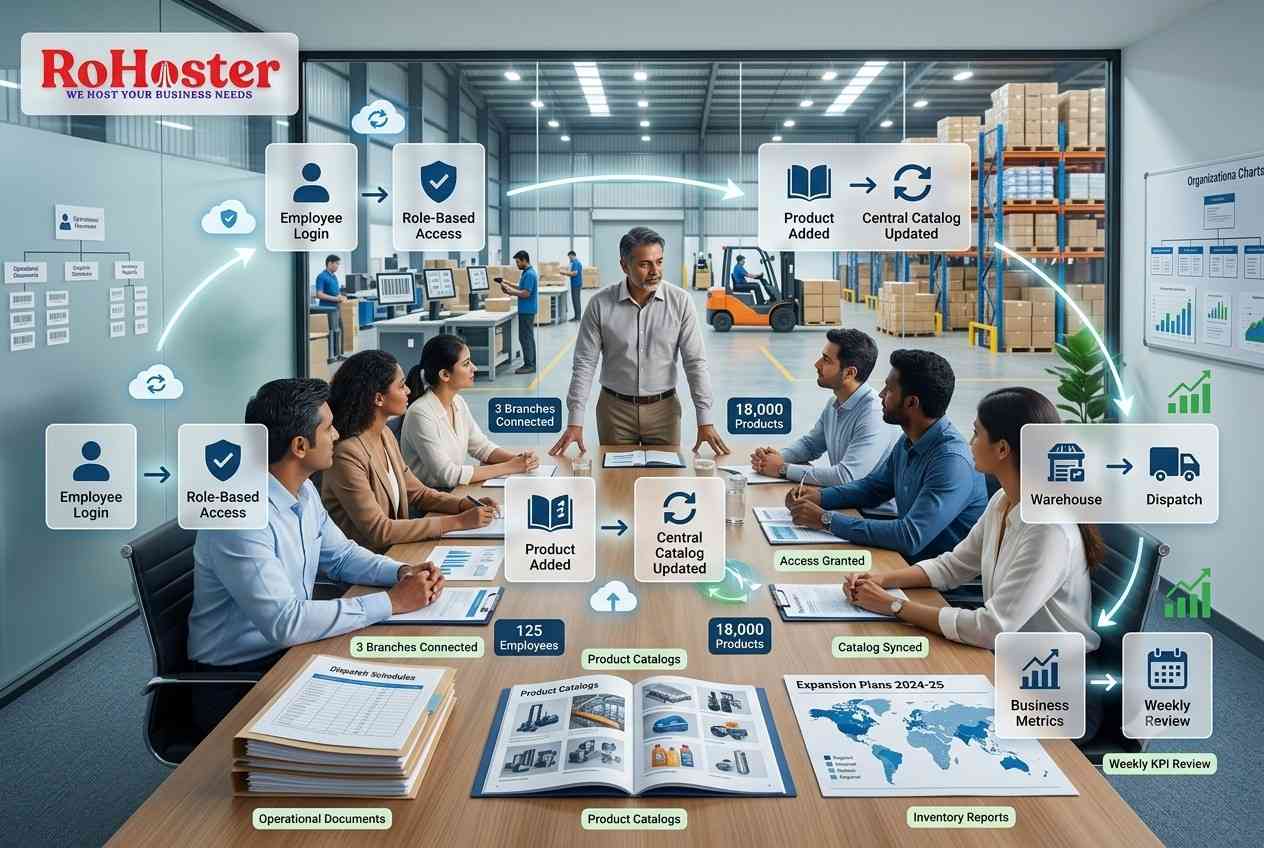
Give Employees Access to Only What They Need
As teams grow, not every employee should have access to every function.
For example:
Sales Team
Customer quotations
Sales orders
Customer information
Warehouse Team
Inventory
Picking
Dispatch
Accounts Team
Billing
Payments
Financial records
Management
Business reports
Performance dashboards
Strategic analytics
Role-based access improves security while reducing accidental errors.
Employees see only the tools required for their responsibilities.
Standardize Business Processes
Successful wholesalers don't rely on individuals doing things "their own way."
Instead, they create consistent workflows.
For example:
Customer Order
↓
Sales Approval
↓
Inventory Allocation
↓
Invoice Generated
↓
Warehouse Picking
↓
Dispatch
↓
Delivery
↓
Payment Collection
Every order follows the same structured process.
Consistency becomes one of the biggest advantages of system-driven operations.
Connect Every Department
A common challenge in growing businesses is disconnected departments.
Sales doesn't know warehouse inventory.
Warehouse doesn't know purchase schedules.
Accounts don't know dispatch status.
Management doesn't know where delays occurred.
A connected business management software allows departments to work from the same operational information instead of maintaining separate records.
Our article What is a Cloud ERP? Essential Features for Modern Trading and Distribution Units explains how centralized cloud platforms connect different departments into one system.
Use Business Metrics Instead of Assumptions
Growing businesses make better decisions when performance is measurable.
Important weekly metrics include:
Sales growth
Gross margin
Inventory turnover
Order fulfillment time
Customer retention
Outstanding collections
Dispatch accuracy
Instead of relying on opinions, management can review measurable performance.
Review Weekly KPIs
Scaling businesses should establish a weekly review process.
Every week, management should ask:
Which products performed best?
Which customers increased purchases?
Which orders were delayed?
Which warehouse achieved the fastest dispatch?
Which salesperson exceeded targets?
Which operational bottlenecks appeared?
Our article The 3 Critical Business Reports Every Wholesale Distributor Must Review Weekly explains how structured reporting supports better management decisions.
Automate Repetitive Operational Tasks
As transaction volumes increase, repetitive work consumes more employee time.
Automation can simplify tasks such as:
Inventory alerts
Invoice generation
Purchase order approvals
Payment reminders
Dispatch notifications
Daily business reports
Instead of increasing administrative workload, businesses can allow software to handle routine activities consistently.
For more ideas, read How to Automate 80% of Daily Repetitive Tasks in a Growing Indian SME.
Track Every Business Activity
System-driven businesses leave an operational trail.
Managers can understand:
Who created an order
Who approved a purchase
When inventory changed
When dispatch occurred
When payment was received
This improves accountability while making operational issues much easier to investigate.
Manage Multiple Branches More Efficiently
Expansion often means opening new warehouses or branch offices.
Without centralized systems, each branch may maintain separate records.
This creates:
Duplicate inventory
Pricing inconsistencies
Delayed reporting
Difficult stock transfers
A centralized cloud platform allows management to monitor multiple locations through one system while each branch continues operating independently.
Make Inventory More Organized
Inventory accuracy becomes increasingly important as businesses scale.
Growing wholesalers should know:
Current stock
Reserved stock
Available stock
Incoming purchases
Fast-moving products
Slow-moving products
Accurate inventory supports better purchasing decisions while reducing excess stock.
Our guide 5 Proven Strategies to Reduce Dead Stock and Free Up Business Cash Flow explains how organized inventory management improves profitability and working capital.
Build Better Customer Management
Scaling businesses shouldn't lose their customer relationships.
Customer information should remain organized as sales volumes increase.
Useful customer information includes:
Purchase history
Credit limits
Outstanding balances
Preferred products
Sales trends
Connecting customer records with lead management also helps businesses monitor new sales opportunities alongside existing accounts.
Prepare for Future Growth
The systems you build today should support tomorrow's expansion.
Ask yourself:
Can your current process handle:
Twice the customers?
Three warehouses?
Ten sales representatives?
Fifty thousand products?
Hundreds of daily orders?
If the answer depends on hiring more people to manage spreadsheets, the business may eventually struggle to scale efficiently.
Replace Firefighting With Planning
Many growing businesses spend most of their time solving yesterday's operational problems.
Missing inventory.
Late dispatches.
Incorrect invoices.
Unapproved discounts.
Poor communication.
System-driven businesses shift management attention toward planning rather than constant troubleshooting.
That creates more time for:
Market expansion
Supplier negotiations
Customer relationships
Product strategy
Business growth
How RoHoster Helps Growing Wholesale Businesses
RoHoster helps wholesalers centralize everyday operations within a cloud-based business management platform.
Rather than depending on multiple disconnected applications, spreadsheets, and manual coordination, businesses can organize operations in one structured environment.
Depending on the enabled modules and business configuration, RoHoster can support:
Inventory management
Sales
Billing
Purchase management
Customer management
Lead management
Business reporting
Multi-user access
Role-based permissions
Cloud-based operations
The objective isn't simply to digitize existing processes.
It's to create systems that continue working as the business grows.
Conclusion
Wholesale businesses don't become difficult to manage because they grow.
They become difficult to manage when their systems don't grow with them.
Moving from manual processes to system-driven operations creates greater consistency, accountability, visibility, and efficiency.
Role-based access, centralized product catalogs, automated workflows, business reporting, and connected departments allow wholesalers to scale confidently without losing operational control.
Because successful growth isn't measured only by bigger sales.
It's measured by building a business that can handle bigger sales—every single day.
Further Reading
Want more practical insights on wholesale management, automation, cloud software, and business growth?