A supplier delivers ₹2 lakh worth of goods today.
Payment is due 30 days later.
Another supplier delivers stock next week with a 15-day credit period. A third requires partial payment immediately and the balance after delivery.
Now multiply this across dozens of suppliers and hundreds of purchase orders.
Suddenly, a simple question becomes surprisingly difficult:
Who needs to be paid, how much, and when?
For wholesalers, distributors, and growing businesses, managing supplier payments through spreadsheets, paper invoices, emails, and memory creates unnecessary risk.
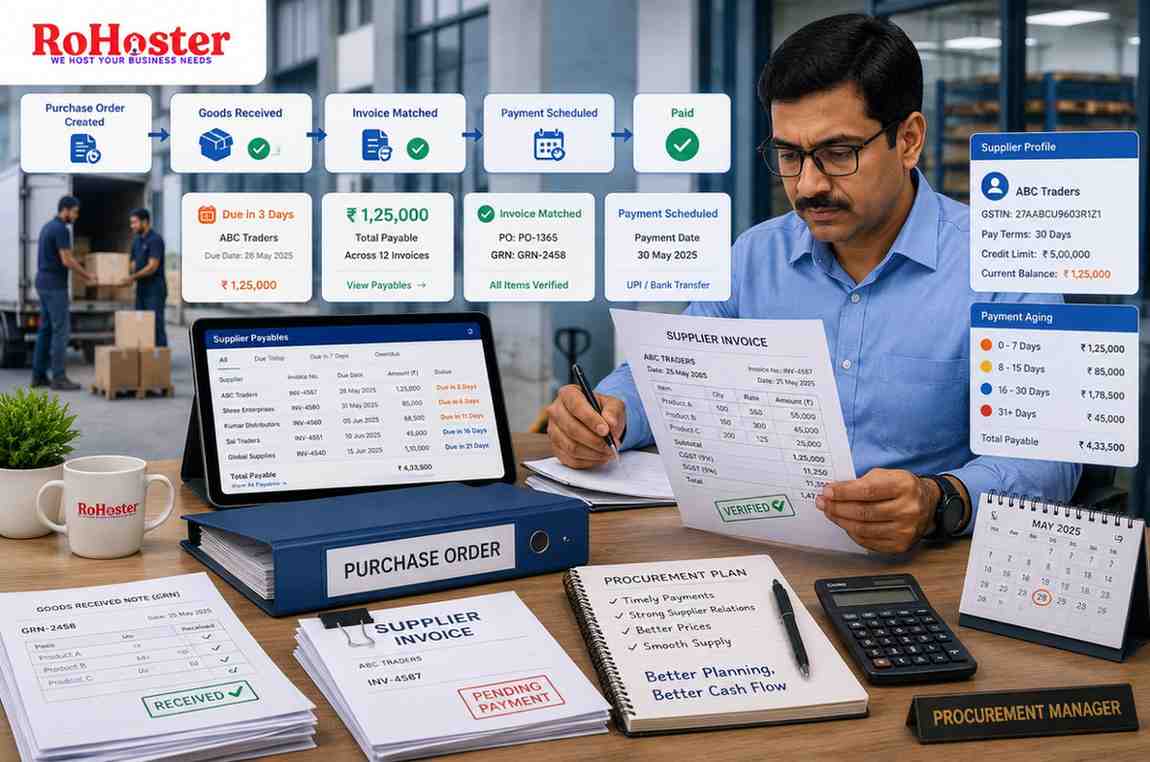
A supplier payment tracking system connects procurement, purchase orders, goods received, invoices, and payment schedules so businesses know exactly what they owe.
Why Supplier Payment Tracking Matters
Supplier relationships depend heavily on reliability.
Repeatedly missing payment deadlines can affect:
- Supplier trust
- Credit terms
- Future pricing negotiations
- Order priority
- Supply continuity
- Business reputation
But paying every invoice immediately isn't necessarily the solution either.
Businesses need to balance supplier commitments with their own cash flow.
The goal is to pay the right supplier, the right amount, at the right time.
Start With a Purchase Order
Good payable management begins before the supplier sends an invoice.
It starts with a structured purchase order.
A purchase order can record important information such as:
- Supplier
- Products ordered
- Quantity
- Agreed price
- Taxes
- Expected delivery date
- Payment terms
- Total order value
Instead of relying on calls or WhatsApp conversations, the business has a clear record of what was actually ordered.
Connect Incoming Goods With the Purchase Order
Suppose you ordered 500 units.
The supplier delivers only 450.
If the invoice is automatically accepted without checking the received quantity, you could end up paying for goods that haven't arrived.
A better procurement workflow is:
Purchase Order → Goods Received → Quantity Verified → Supplier Invoice → Payment
When incoming inventory is linked with the original purchase order, businesses can verify what was actually received before approving payment.
This is particularly important for wholesalers and distributors handling large quantities of stock.
Match Supplier Invoices Before Payment
A supplier invoice shouldn't exist in isolation.
Ideally, the business should compare three pieces of information:
What was ordered?
What was received?
What was invoiced?
If all three match, the invoice can move toward approval.
If there is a difference, the team can investigate before money leaves the business.
For example:
Purchase Order: 500 units
Goods Received: 450 units
Invoice: 500 units
That discrepancy needs attention.
A structured purchase order management system makes these differences easier to identify.
Record Every Supplier's Payment Terms
Different suppliers may offer different credit periods.
Supplier A: 7 days
Supplier B: 15 days
Supplier C: 30 days
Supplier D: 45 days
Trying to remember all these deadlines manually becomes increasingly difficult as procurement grows.
A supplier payment tracking system can associate payment terms with supplier invoices and calculate upcoming due dates.
That gives the finance or procurement team a clearer payment schedule.
Use Payment Aging to Prioritize Payables
Not every payable requires immediate action.
Payment aging helps businesses organize outstanding supplier invoices based on when they are due.
For example:
Due Today
Due Within 7 Days
Due Within 15 Days
Due Within 30 Days
Overdue
This gives procurement and finance teams a much clearer view of upcoming commitments.
Instead of discovering a payment on its due date, businesses can plan for it beforehand.
Get Alerts Before a Payment Becomes Overdue
The best payment reminder is the one that arrives before the deadline.
Businesses can use upcoming-due alerts to identify invoices requiring attention.
For example:
ABC Suppliers
Amount Due: ₹75,000
Due Date: 28 July
Status: Due in 3 Days
Now the finance team has time to verify the invoice, check available funds, obtain approvals, and schedule payment.
That is far more efficient than receiving a supplier call asking why payment hasn't arrived.
Know Your Total Supplier Liability
Looking at individual invoices is useful.
But business owners also need the bigger picture.
How much does the company currently owe suppliers?
Suppose your payable summary shows:
Total Supplier Payables: ₹8,50,000
Due This Week: ₹2,10,000
Due Next Week: ₹1,75,000
Due Later: ₹4,65,000
This information helps management understand upcoming cash requirements.
It also makes short-term financial planning much easier.
Supplier Payables and Cash Flow Are Connected
Payables should never be viewed separately from the rest of your business finances.
Imagine ₹3 lakh of supplier payments are due next week.
If the business only has ₹2 lakh available, management needs to know beforehand—not on payment day.
This is why supplier payment information becomes much more useful when combined with daily sales, expenses, and cash-flow visibility.
Our article Track Daily Sales, Cash-in-Hand, and Business Expenses Without the Hassle explains how businesses can maintain a clearer picture of everyday cash movement.
Don't Confuse Expenses With Payments
There is an important difference between recording an expense and actually paying it.
Suppose goods worth ₹1 lakh arrive today with a 30-day payment term.
The business has incurred a liability, but the cash hasn't left yet.
A good business management software should help maintain visibility over outstanding obligations so owners don't mistake current cash availability for money that is completely free to spend.
This distinction becomes increasingly important as businesses purchase more inventory on supplier credit.
Use Supplier History During Negotiations
Structured procurement records can also help businesses understand supplier relationships over time.
You may be able to review information such as:
- Purchase frequency
- Total purchase value
- Payment history
- Product pricing
- Outstanding balances
- Delivery performance
This gives businesses more context when negotiating pricing or payment terms.
For example, a long-term supplier receiving consistent orders and timely payments may be more willing to offer better credit terms.
Connect Procurement With Inventory
Purchasing shouldn't operate separately from inventory.
If your warehouse already has excess stock, automatically placing another large purchase order can unnecessarily lock up working capital.
Inventory visibility helps procurement teams understand what actually needs to be reordered.
Our article 5 Proven Strategies to Reduce Dead Stock and Free Up Business Cash Flow explains why purchasing decisions should consider slow-moving inventory and stock turnover before additional capital is committed.
Track Batch-Sensitive Incoming Goods
For pharmaceutical, food, and FMCG distributors, receiving goods involves more than checking quantities.
Teams may also need to record information such as batch numbers and expiry dates.
Connecting receiving workflows with structured inventory records makes this process easier to manage.
Our guide Why Expiry Date and Batch Tracking Is Critical for Food & Pharma Distributors explores why batch visibility is especially important for expiry-sensitive inventory.
Centralize Supplier Records
Supplier information is often scattered across multiple places.
One employee has a phone number.
Another has the latest invoice.
Payment information is stored in accounting records.
Purchase history is somewhere else.
Centralized software for small business can create more structured supplier records containing important procurement information.
This reduces dependence on individual employees and makes historical information easier to access.
Make Purchase Approvals More Structured
As businesses grow, not every employee should be able to place large orders without oversight.
A structured procurement process can involve steps such as:
Purchase Requirement → Purchase Order → Approval → Supplier → Goods Received → Invoice Verification → Payment
This creates accountability.
It also helps management understand why purchases were made and whether they were properly authorized.
Monitor Procurement Costs Over Time
Supplier data can reveal valuable trends.
Perhaps a raw material that cost ₹500 per unit six months ago now costs ₹580.
Maybe one supplier consistently charges more than another.
Or transportation costs associated with certain purchases are increasing.
Tracking procurement information over time gives businesses more data for supplier comparison and cost control.
That ultimately affects profitability.
Our article Understanding Your True Margin: How Live P&L Dashboards Guide Smarter Decisions explains why controlling expenses and purchasing costs is critical for protecting business margins.
Reduce Dependence on Spreadsheets
A spreadsheet can track supplier payments when a business has five suppliers.
It becomes considerably harder when there are 50 suppliers, hundreds of invoices, multiple payment terms, partial deliveries, and frequent purchases.
Rows have to be updated manually.
Due dates can be missed.
Invoice statuses become outdated.
Multiple employees may even maintain different versions of the same file.
A centralized system creates one structured source for procurement and payable information.
How RoHoster Can Support Better Procurement Management
RoHoster helps businesses bring important operational information into a centralized cloud-based environment.
For wholesalers, distributors, and growing SMEs, better organization of purchasing, inventory, supplier records, and financial information can improve visibility across operations.
Depending on the implemented configuration and available features, RoHoster can support areas such as:
- Supplier information
- Purchase records
- Inventory
- Expense information
- Billing
- Business reporting
- Cloud-based access
The objective is to reduce scattered records and give business owners a clearer picture of operational commitments.
Conclusion
Managing supplier payments isn't simply about remembering due dates.
It begins with knowing what was ordered, what arrived, what was invoiced, what is owed, and when payment is due.
A structured supplier payment tracking system brings these pieces together.
By connecting purchase orders, incoming goods, supplier invoices, payment aging, and cash-flow planning, businesses can reduce missed payments while maintaining better control over working capital.
Because good procurement isn't finished when the goods arrive.
It's finished when the entire transaction is accounted for.
Further Reading
Want more practical insights on procurement, inventory, cash flow, and business operations?
Read the latest business insights from LarchSoft on LinkedIn