Manufacturing has always been about efficiency.
Every raw material.
Every machine.
Every production batch.
Every finished product.
Every delay.
Every mistake.
Small manufacturing businesses often manage these activities using notebooks, Excel sheets, phone calls, and handwritten production registers.
While this approach may work in the beginning, growing production volumes make manual management increasingly difficult.
That is why more businesses are adopting digital transformation for manufacturing units in India through affordable ERP solutions.
Modern ERP software helps manufacturers organize production, inventory, purchasing, and reporting in one connected system.
Manufacturing Is More Than Production
Many factory owners believe manufacturing is simply about producing finished goods.
In reality, every product passes through multiple stages.
Raw materials are purchased.
Inventory is checked.
Production is planned.
Workers assemble products.
Quality inspections are completed.
Finished goods are stored.
Orders are dispatched.
If these activities are disconnected, delays and mistakes become inevitable.
A connected business management software helps every department work with the same information.
Why Small Manufacturers Need Digital Systems
As businesses grow, manual systems begin creating operational problems.
Common challenges include:
Raw material shortages
Production delays
Inventory mismatches
Incorrect production planning
Difficulty tracking work orders
Delayed purchasing
Slow reporting
Digital systems reduce these problems by organizing operational information in one place.
What Is a Manufacturing ERP?
Manufacturing ERP is software that connects factory operations.
Instead of managing production through multiple spreadsheets, manufacturers can centralize:
Raw materials
Production planning
Inventory
Purchasing
Finished goods
Quality checks
Sales
Business reports
This improves visibility while reducing repetitive manual work.
Simplify Bill of Materials (BOM)
Every manufactured product begins with a recipe.
In manufacturing, this recipe is known as the Bill of Materials (BOM).
A BOM defines:
Raw materials required
Components
Quantities
Assembly sequence
Production instructions
Without a structured BOM, production teams often rely on memory or paper documents.
ERP software allows manufacturers to standardize BOMs so every production batch follows the same process.
This reduces waste while improving consistency.
Plan Raw Materials More Efficiently
Production cannot begin without materials.
Manufacturers need visibility into:
Available stock
Incoming purchases
Material consumption
Safety stock
Reorder levels
Instead of discovering shortages after production starts, ERP software helps businesses prepare in advance.
This minimizes production interruptions.
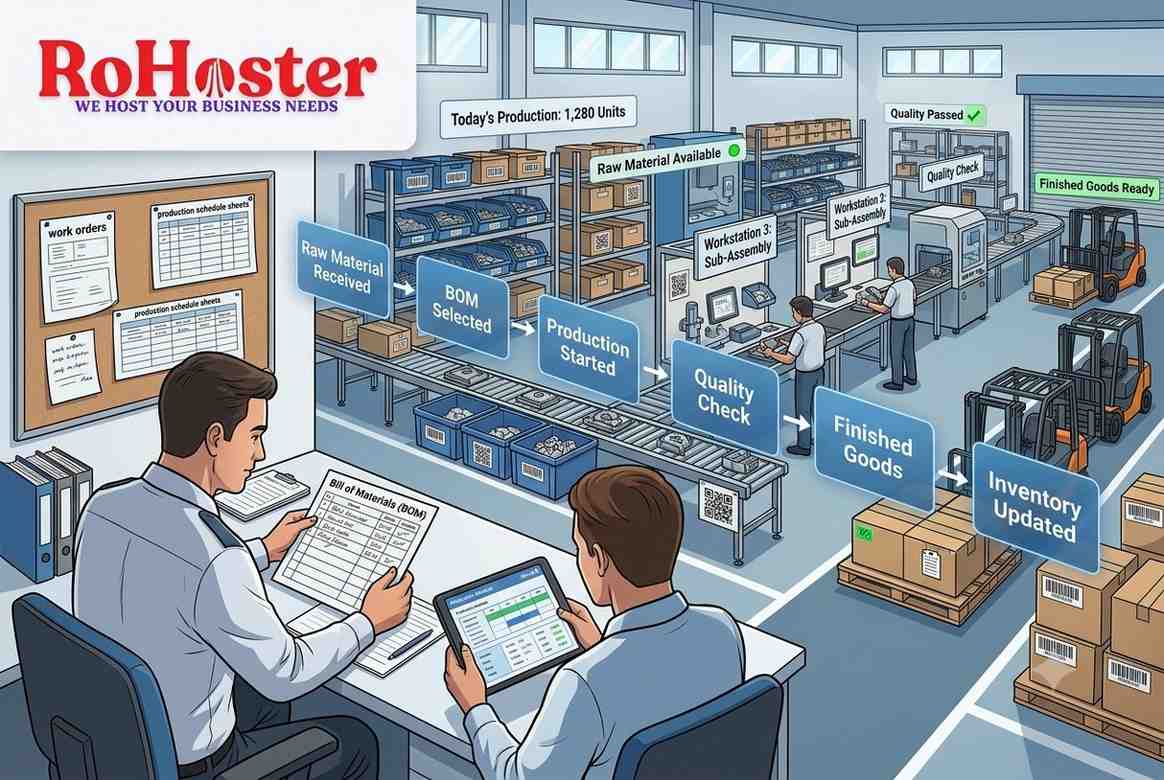
Track Production Stage by Stage
Every manufacturing order passes through multiple steps.
For example:
Raw Material Issued
↓
Production Started
↓
Assembly
↓
Quality Inspection
↓
Finished Goods
↓
Warehouse
↓
Dispatch
Tracking every stage helps management identify delays before they become expensive problems.
Monitor Daily Factory Output
Factory managers need answers every day.
Questions such as:
How many units were produced?
Which production line performed best?
Which orders remain incomplete?
Which machine experienced downtime?
How much raw material was consumed?
ERP software transforms these questions into measurable production reports.
Instead of waiting until the end of the month, managers receive visibility every day.
Inventory Should Update Automatically
Every production activity changes inventory.
Raw materials decrease.
Finished goods increase.
Manual updates often create mismatches between physical stock and recorded inventory.
A connected ERP automatically reflects these changes after production is completed.
Our article What is a Cloud ERP? Essential Features for Modern Trading and Distribution Units explains how connected systems keep inventory synchronized across business operations.
Improve Quality Control
Quality problems are expensive.
Defective products create:
Customer complaints
Material waste
Rework
Delivery delays
ERP software allows manufacturers to record quality inspections during production rather than discovering issues after dispatch.
Businesses can monitor:
Inspection results
Batch quality
Rejected products
Rework quantities
Quality trends
This supports continuous operational improvement.
Purchase Management Becomes Smarter
Manufacturing depends on reliable suppliers.
ERP software helps manage:
Purchase orders
Supplier deliveries
Material receipts
Outstanding supplier invoices
Payment schedules
Connecting purchasing with inventory reduces both shortages and excessive stock.
For more on procurement, read Never Miss a Due Date: How to Manage Supplier Payables and Purchase Orders.
Business Reports Drive Better Decisions
Factory owners should not rely solely on production numbers.
Important reports include:
Raw material consumption
Production efficiency
Daily output
Machine utilization
Inventory movement
Product profitability
Supplier performance
Instead of spending hours preparing spreadsheets, management can review structured reports.
Our guide The 3 Critical Business Reports Every Wholesale Distributor Must Review Weekly demonstrates how meaningful reporting supports better decision-making across industries.
Cloud ERP Helps Owners Stay Connected
Owners are not always inside the factory.
They may be:
Meeting customers
Visiting suppliers
Opening new facilities
Traveling
Cloud ERP allows authorized users to review:
Production
Inventory
Purchases
Business reports
Sales
from anywhere with internet access.
Multi-User Collaboration Improves Productivity
Manufacturing involves multiple departments.
Production.
Warehouse.
Purchasing.
Accounts.
Sales.
Management.
Instead of each department maintaining separate records, ERP creates one centralized information system.
Everyone works from the same operational data.
Automation Reduces Manual Work
Factories perform many repetitive administrative tasks.
Examples include:
Production reports
Purchase approvals
Inventory updates
Stock alerts
Supplier reminders
Daily production summaries
Automation allows software to handle routine activities consistently.
Our article How to Automate 80% of Daily Repetitive Tasks in a Growing Indian SME explains how automation improves operational efficiency.
Digital Transformation Doesn't Require Large Budgets
Many small manufacturers believe ERP is only for large factories.
Today's cloud-based solutions make digital transformation much more accessible.
Businesses can begin with essential operational modules and expand as requirements grow.
The objective is not to digitize everything overnight.
It is to create better systems gradually.
Prepare for Future Growth
As manufacturing expands, businesses often introduce:
More products
Additional production lines
New employees
Multiple warehouses
Larger customer bases
Without structured systems, complexity increases rapidly.
Businesses that adopt organized digital operations early find expansion much easier to manage.
How RoHostter Helps Manufacturing Businesses
RoHostter helps manufacturing businesses organize operations through one centralized cloud-based business management platform.
Depending on factory requirements and enabled modules, RoHostter can support:
Production planning
Bill of Materials (BOM)
Inventory management
Purchasing
Sales
Business reporting
Customer management
Lead management
Multi-user collaboration
Cloud-based operations
Instead of managing production through disconnected registers and spreadsheets, manufacturers can centralize operational information and improve visibility across the factory.
Conclusion
Digital transformation is no longer reserved for large manufacturing companies.
Affordable ERP solutions allow micro and small manufacturing units to organize production, simplify inventory, standardize BOMs, improve reporting, and prepare for long-term growth.
Because manufacturing success depends on more than producing products.
It depends on building systems that produce consistently, efficiently, and intelligently.
Further Reading
Want more practical insights on manufacturing, automation, cloud software, and business growth?