Your business is profitable.
Sales are growing. Customers are buying. Your P&L statement shows a positive number.
And yet, salary day arrives—and suddenly there isn't enough cash in the bank.
How?
Because profit and cash flow are not the same thing.
A business can look profitable on paper while its money remains stuck in unpaid customer invoices, excess inventory, or future receivables.
Meanwhile, salaries, rent, suppliers, taxes, and operating expenses still need to be paid.
For growing SMEs, understanding cash flow management isn't just good financial practice. It can determine whether growth is sustainable at all.
How Can a Profitable Business Run Out of Money?
Consider a business that generates ₹12 lakh in monthly sales.
Its monthly expenses are ₹9 lakh.
On paper:
Revenue: ₹12 lakh
Expenses: ₹9 lakh
Profit: ₹3 lakh
Looks healthy.
But suppose ₹5 lakh of those sales were made on credit and customers haven't paid yet.
The business has recorded the revenue—but doesn't have the cash.
At the same time, suppliers and employees expect payment.
That's how a profitable SME can suddenly experience a cash crunch.
Profit Tells You Performance. Cash Flow Tells You Survival.
Profit measures whether your business earns more than it spends over a period.
Cash flow measures when money actually enters and leaves the business.
You need both.
Our article Understanding Your True Margin: How Live P&L Dashboards Guide Smarter Decisions explains how gross and net margins reveal profitability.
But even strong margins won't protect a business if incoming cash consistently arrives later than outgoing payments.
Delayed Receivables Are a Major Cash-Flow Risk
Imagine you invoice a customer ₹2 lakh today with 45-day payment terms.
The sale appears in your records immediately.
But the actual ₹2 lakh may not reach your bank account for another month and a half.
Now imagine this happening across ten customers.
Suddenly, a substantial amount of your working capital is sitting outside the business.
This is why growing SMEs need to monitor:
- Total outstanding receivables
- Customer-wise balances
- Invoice due dates
- Overdue payments
- Average collection time
The objective isn't simply to know how much you've sold.
It's to know how much you've actually collected.
Track Receivables by Age
Not every unpaid invoice has the same level of risk.
An invoice issued yesterday is very different from one that has been unpaid for 90 days.
Businesses can organize receivables into aging periods such as:
0–30 Days
31–60 Days
61–90 Days
90+ Days
This helps management identify which customers require immediate follow-up.
The longer money remains unpaid, the longer the business has to finance operations without that cash.
For retailers and businesses offering customer credit, Moving Beyond the Red Khata: Digitizing Customer Udhaar and Credit Limits explains how structured credit limits and payment tracking can improve control over outstanding balances.
Know Your Operational Run Rate
Another important cash-flow metric is your operational run rate or burn rate.
In simple terms:
How much cash does your business typically need to operate each month?
Suppose your recurring monthly commitments include:
Salaries: ₹3 lakh
Rent: ₹80,000
Utilities: ₹40,000
Marketing: ₹60,000
Transportation: ₹70,000
Other Expenses: ₹50,000
Your regular operating requirement is approximately:
₹6 lakh per month
Knowing this number helps you understand how much liquidity the business needs simply to keep operating.
How Long Could Your Business Survive With No New Cash?
This is where cash reserves become important.
Suppose your business has ₹12 lakh available and typically requires ₹6 lakh per month to operate.
You have roughly two months of operating coverage, before considering other inflows or obligations.
This doesn't mean businesses should expect sales to suddenly stop.
The metric simply helps owners understand their financial buffer.
If your cash reserve covers only a few weeks of operations, delayed customer payments become much more dangerous.
Don't Look at Expenses Only After They Happen
Cash-flow management isn't just about collecting money faster.
It's also about understanding what will leave the business.
Owners should maintain visibility over upcoming:
- Salaries
- Supplier payments
- Rent
- Loan payments
- Taxes
- Utility bills
- Software subscriptions
- Inventory purchases
If ₹8 lakh of payments are due next month, management should know before those due dates arrive.
Our article Never Miss a Due Date: How to Manage Supplier Payables and Purchase Orders explains how payment aging and purchase-order tracking can help businesses anticipate supplier obligations.
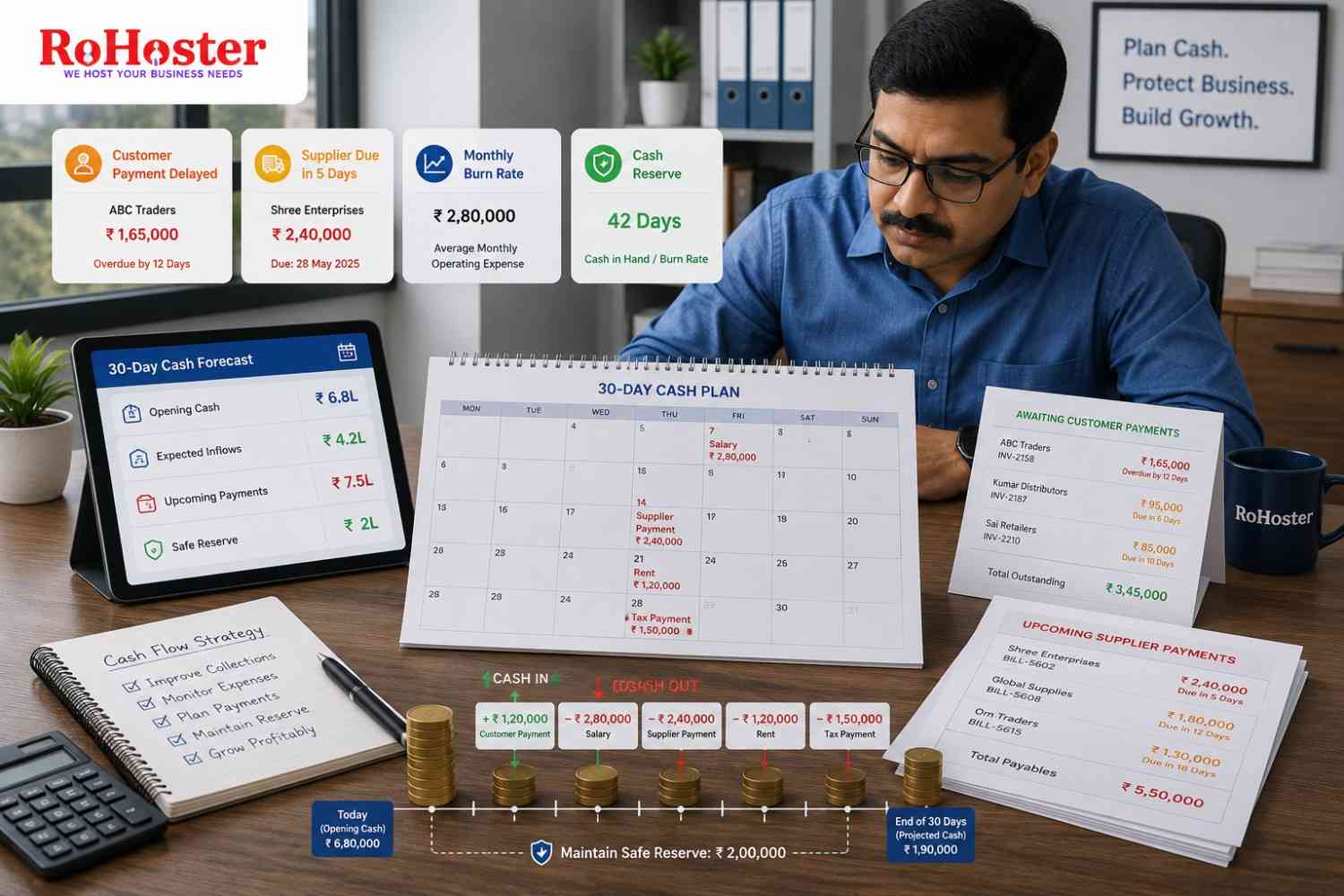
Build a 30-Day Cash Forecast
One of the simplest ways to improve cash-flow management is to stop looking only at today's bank balance.
Instead, ask:
What will my cash position look like 30 days from now?
A basic forecast could consider:
Current Cash
Expected Customer Payments
Expected Cash Sales
−
Supplier Payments
−
Salaries
−
Rent & Utilities
−
Taxes
−
Other Operating Expenses
=
Projected Cash Balance
This gives owners an early warning if future obligations are likely to exceed available cash.
Forecasting Gives You Time to Act
Imagine today's cash balance looks healthy at ₹10 lakh.
But your forecast shows:
Supplier Payments: ₹4 lakh
Salaries: ₹3 lakh
Taxes: ₹1.5 lakh
Other Expenses: ₹1 lakh
Total upcoming cash outflow: ₹9.5 lakh.
Meanwhile, expected customer collections are delayed.
Your current ₹10 lakh balance suddenly doesn't look quite as comfortable.
The benefit of forecasting isn't predicting the future perfectly.
It's identifying potential problems before they become emergencies.
Maintain a Cash Reserve
A growing business shouldn't treat every rupee in the bank as immediately available for expansion.
Maintaining a cash reserve can provide protection against:
- Delayed customer payments
- Unexpected repairs
- Seasonal sales declines
- Supplier price increases
- Emergency inventory requirements
- Unexpected operating costs
The appropriate reserve varies by business, but owners should understand how many weeks or months of essential operations their available cash can support.
Watch Daily Cash Movement
Monthly cash-flow analysis is useful, but many warning signs appear much earlier.
Businesses should monitor everyday movements such as:
Cash In
Sales collections
Customer payments
Other business receipts
Cash Out
Purchases
Wages
Transportation
Utilities
Operating expenses
Consistent daily records create much better inputs for future forecasts.
Our guide Track Daily Sales, Cash-in-Hand, and Business Expenses Without the Hassle explains how daily closing and expense categorization can provide better visibility into actual cash movement.
Inventory Can Quietly Consume Your Cash
Imagine spending ₹5 lakh purchasing inventory.
That money hasn't disappeared from your balance sheet—the business now owns ₹5 lakh worth of stock.
But your cash is still gone until those products sell and customers pay.
If inventory moves slowly, significant working capital can remain trapped on warehouse shelves.
This is why inventory turnover matters to cash-flow management.
Buying too much stock can create liquidity problems even when the business appears financially healthy.
Growth Can Actually Make Cash Flow Worse
This sounds counterintuitive, but rapid growth can create serious cash-flow pressure.
Imagine your sales double.
Great.
But now you also need:
- More inventory
- More employees
- More warehouse capacity
- Higher supplier purchases
- Additional transportation
- Greater marketing expenditure
Many of these costs occur before customer payments arrive.
So the faster the company grows, the more working capital it may require.
This is why growing SMEs need to monitor cash flow just as carefully as revenue.
Scenario Planning Makes Forecasts More Useful
No forecast will be perfectly accurate.
Instead of relying on one prediction, businesses can model different scenarios.
Expected Scenario: Customers pay approximately on time.
Conservative Scenario: Major customer payments arrive 15 days late.
Stress Scenario: Sales decline while expenses remain stable.
Now management can ask:
Would we still have enough cash to meet essential commitments?
This makes financial planning much more practical.
Why Spreadsheets Become Difficult as the Business Grows
A spreadsheet may work when there are only a handful of transactions.
But a growing SME may have:
- Hundreds of invoices
- Multiple payment methods
- Dozens of customers
- Multiple suppliers
- Recurring expenses
- Credit transactions
- Inventory purchases
Cash-flow forecasting becomes increasingly difficult when information is scattered across separate files.
Modern business management software can organize operational information more consistently, giving owners better inputs for financial planning.
How Software Helps Prevent Cash-Flow Surprises
A useful software for small business doesn't magically create cash.
What it can create is visibility.
By organizing information across sales, expenses, customers, suppliers, inventory, and payments, business owners can understand:
What has been collected?
What is still receivable?
What needs to be paid?
When is it due?
How much cash may remain afterward?
That visibility gives management more time to make decisions.
How RoHoster Can Help
RoHoster helps growing businesses centralize important operational information instead of relying on disconnected registers, files, and spreadsheets.
Depending on the implemented configuration and available features, businesses can use RoHoster to support areas such as:
- Sales records
- Customer information
- Expense records
- Supplier information
- Billing
- Inventory
- Business reporting
- Cloud-based access
When operational information is organized, businesses can build a much clearer understanding of their cash position and upcoming commitments.
The goal isn't simply to know how much money you have today.
It's to understand what your business may need tomorrow.
Conclusion
Businesses rarely experience cash-flow crises because they suddenly forgot how to sell.
The problem often develops quietly.
Customers pay later.
Inventory absorbs capital.
Expenses increase.
Supplier deadlines approach.
And eventually, the timing between cash coming in and cash going out becomes unsustainable.
Effective SME cash flow management means monitoring receivables, understanding operational run rates, planning upcoming payments, maintaining appropriate reserves, and forecasting future cash requirements.
Because profitability tells you whether your business model works.
Cash flow determines whether your business can keep operating long enough to benefit from that profit.
Further Reading
Want more practical insights on cash flow, profitability, financial management, and SME operations?
Read the latest business insights from LarchSoft on LinkedIn