Getting a new customer through the door is valuable.
Getting that customer to come back again—and again—is where a strong retail business starts to build momentum.
Yet many local retailers focus heavily on attracting new buyers while barely using the information they already have about existing customers.
A customer may have purchased from your store five times.
You may know what they bought, when they bought it, how much they spent, and which categories they prefer.
But if that information simply remains buried inside old invoices, you're missing an opportunity.
Using customer purchase history intelligently can help local retailers create more relevant offers, improve customer relationships, and generate repeat sales without sending the same promotion to everyone.
Why Existing Customers Matter
Imagine two customers walk into your store.
Customer A has never purchased from you before.
Customer B has purchased eight times during the past year and regularly buys products from one particular category.
Should both customers receive exactly the same communication?
Probably not.
Customer B has already given you useful information about their preferences.
A structured retail customer management system allows businesses to use this history instead of treating every customer like a stranger.
Start Building a Customer Purchase History
Every transaction can tell you something about the customer.
Depending on the information your business collects appropriately, a customer profile could contain:
- Previous purchases
- Purchase dates
- Product categories
- Total spending
- Average purchase value
- Preferred products
- Last purchase date
- Contact information
Over time, these records create a much clearer picture of customer behaviour.
Instead of asking, "What promotion should we send everyone?"
you can start asking, "Which offer would actually matter to this customer?"
Identify Your Most Valuable Customers
Not every customer contributes equally to revenue.
Some customers purchase once and never return.
Others visit every month.
A retailer can segment customers based on factors such as:
Purchase Frequency – How often do they buy?
Total Spending – How much have they spent overall?
Recent Activity – When did they last purchase?
Average Order Value – How much do they typically spend?
This helps businesses identify their most loyal and valuable customers.
These customers can then receive early access to new products, exclusive offers, or personalized communication.
Use Purchase Categories to Make Offers Relevant
Suppose you own a boutique.
One customer frequently purchases ethnic wear.
Another primarily buys western wear.
A third usually purchases accessories.
Sending all three customers the same discount isn't particularly personalized.
Instead, purchase history can help you create targeted communication.
For example:
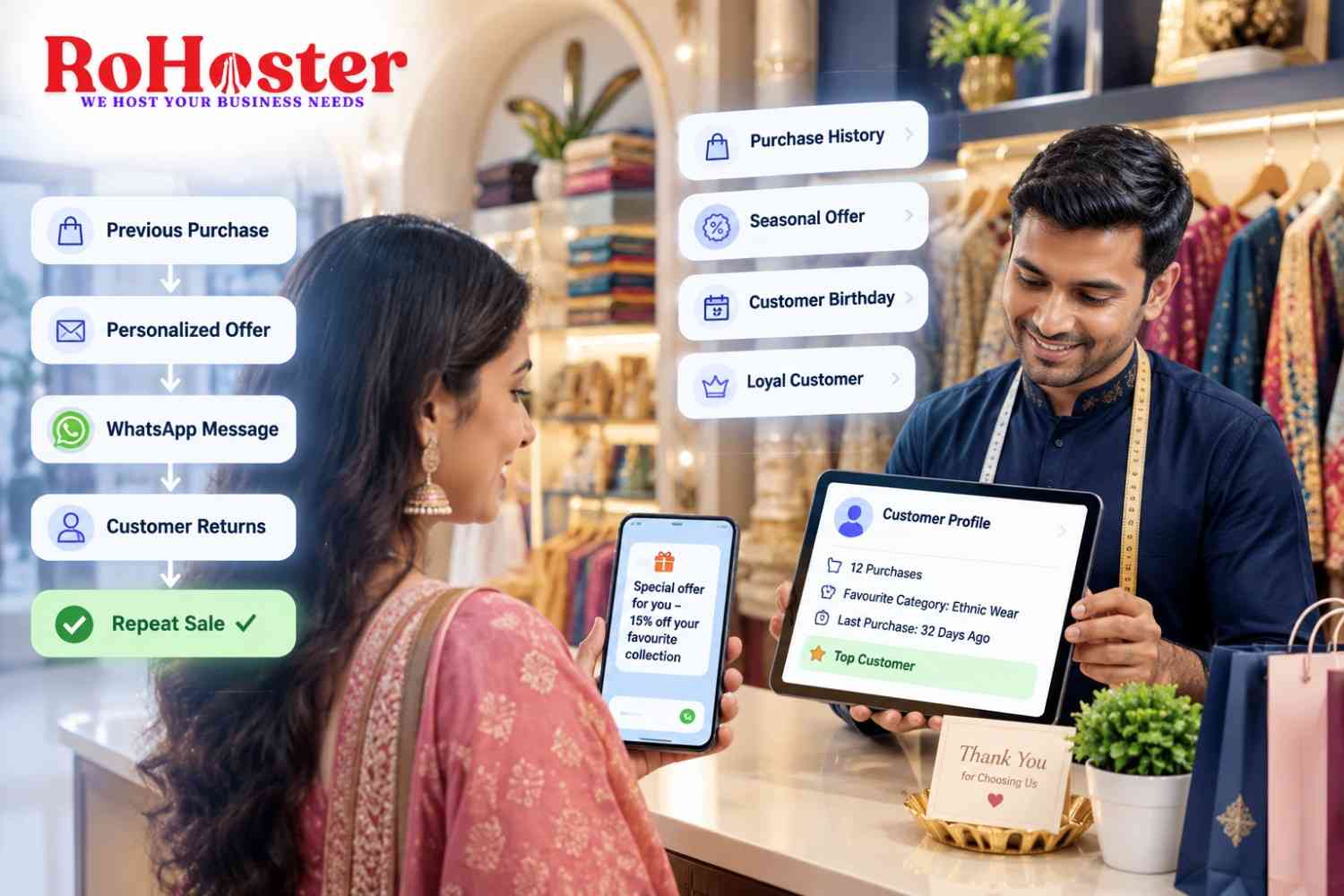
"New ethnic collection just arrived. As one of our regular customers, enjoy 15% off this weekend."
That message is much more relevant to someone who regularly buys ethnic clothing.
Relevant offers feel useful.
Generic promotions often feel like advertising.
Use Seasonal Purchase Patterns
Purchase history becomes even more valuable when combined with timing.
Perhaps a customer purchased festive clothing before Diwali last year.
Another regularly buys gifts during the wedding season.
A retailer can use these patterns to send timely offers before similar buying occasions.
For example:
Last year's festive buyer → New festive collection alert
Regular winter buyer → Winter collection launch
Frequent gift buyer → Festive gifting promotion
The objective is to reach customers when they are most likely to need the product.
Bring Customer Information Into Your Billing Process
Customer retention becomes easier when billing and customer records work together.
Every completed transaction can contribute to the customer's history.
Instead of maintaining customer details in one system and invoices somewhere else, connected business management software can create more organized records from everyday transactions.
This gives retailers useful customer information without requiring employees to manually update separate spreadsheets after every sale.
Identify Customers Who Haven't Returned
Purchase history isn't only useful for identifying your best customers.
It can also reveal customers who are becoming inactive.
Suppose a regular customer previously purchased every month but hasn't visited for 90 days.
That could trigger a simple re-engagement campaign:
"We haven't seen you in a while. Here's 10% off your next visit."
Not every customer will return.
But identifying inactive customers gives businesses an opportunity to reconnect before the relationship disappears completely.
Use WhatsApp for Personalized Customer Communication
For many Indian retailers, WhatsApp is already one of the easiest ways to communicate with customers.
But there is a major difference between sending generic promotional broadcasts and sending relevant messages.
Instead of:
"SALE! 20% OFF EVERYTHING!"
consider:
"Hi Priya, our new handbag collection has arrived. Since you've shopped this category with us before, here's an exclusive offer for this weekend."
The second message feels far more personal because it uses actual customer context.
The goal isn't to message customers more often.
It's to make each message more relevant.
Reward Your Best Customers
Purchase history can also help identify customers who deserve loyalty benefits.
For example:
10+ Purchases → Loyal Customer
₹50,000+ Lifetime Spend → Premium Customer
5 Purchases in 90 Days → Frequent Buyer
Retailers can then create rewards such as:
- Exclusive discounts
- Early access to sales
- New collection previews
- Birthday offers
- Priority service
- Special seasonal promotions
These don't always need to be large discounts.
Sometimes recognition itself strengthens customer relationships.
Don't Over-Discount Loyal Customers
There is also a danger in using discounts too aggressively.
If a customer already purchases regularly at full price, constantly offering discounts may unnecessarily reduce your margins.
Instead, retailers can use customer data to decide when a discount is actually needed.
A loyal active customer might receive early product access.
An inactive customer might receive a comeback discount.
A high-value customer might receive a special seasonal benefit.
This creates a smarter retention strategy than simply giving everyone 20% off.
Our article Understanding Your True Margin: How Live P&L Dashboards Guide Smarter Decisions explains why businesses should consider profitability—not just sales volume—when planning discounts.
Use Purchase History for Better Product Recommendations
Customer history can also improve cross-selling.
Suppose someone buys a formal shirt.
The retailer might later recommend:
- Trousers
- Belts
- Formal shoes
- Accessories
Or a customer who regularly purchases skincare products could receive recommendations when complementary products become available.
The key is relevance.
Good recommendations help customers discover useful products rather than making them feel like they're receiving random promotions.
Automate Follow-Ups Instead of Remembering Everything
Personalized retention doesn't mean employees need to manually remember every customer's purchase history.
Automation can help trigger communication based on predefined conditions.
For example:
Customer hasn't purchased for 60 days
↓
Re-engagement message sent
Or:
Customer reaches 10 purchases
↓
Loyalty offer generated
Or:
Seasonal campaign begins
↓
Relevant customer segment receives offer
This is where retail marketing automation becomes particularly useful.
Our article How to Automate 80% of Daily Repetitive Tasks in a Growing Indian SME explains how businesses can automate repetitive communication and operational workflows instead of relying entirely on manual follow-ups.
Track Whether Your Offers Actually Work
Sending promotions is only half the process.
Retailers should also understand whether customers actually return after receiving them.
Useful questions include:
- How many customers received the offer?
- How many returned?
- How much did they spend?
- Which customer segment responded best?
- Which offer generated the strongest repeat sales?
This helps businesses improve future campaigns.
Marketing becomes based on results rather than assumptions.
Customer Retention Can Improve Cash Flow
Repeat customers can also make revenue more predictable.
If a business consistently retains customers, it doesn't need to rebuild its customer base from zero every month.
A stronger base of returning customers can provide more consistent sales and make planning easier.
For growing SMEs, predictable collections and expenses are particularly important.
Our guide Why Cash Flow Crises Kill Profitable SMEs (And How Software Prevents It) explains why visibility and predictability become increasingly important as a business scales.
Keep Customer Records Organized
Many local businesses already know their customers extremely well.
The shop owner remembers names, preferences, and previous purchases.
But that knowledge becomes harder to maintain as the business grows.
New employees join.
Customer numbers increase.
More outlets open.
Thousands of transactions accumulate.
Using software for small business allows customer knowledge to become part of the business system rather than remaining only in the owner's memory.
Don't Forget Customer Consent and Preferences
Personalization should improve the customer experience, not overwhelm people.
Businesses should communicate responsibly and respect customer preferences regarding promotional messages.
Customers who don't want marketing communication shouldn't be repeatedly contacted.
The objective is to build stronger relationships through relevant communication—not simply increase message volume.
How RoHoster Can Help
RoHoster helps businesses organize customer and operational information in one centralized cloud environment.
For retailers, connecting customer records with everyday business activity can create better visibility into customer relationships and purchase patterns.
Depending on the available features and configuration, RoHoster can support areas such as:
- Customer records
- Purchase information
- Billing
- Lead management
- Sales records
- Business reporting
- Customer communication workflows
- Cloud-based access
Instead of treating every transaction as the end of a customer journey, businesses can use organized customer information to create opportunities for the next purchase.
Conclusion
Your previous sales contain clues about your future sales.
They show who your best customers are, what they prefer, when they purchase, and when they stop coming back.
By using customer purchase history effectively, local retailers can create more relevant promotions, identify loyal customers, reconnect with inactive buyers, and build stronger long-term relationships.
You don't necessarily need to send more offers.
You need to send better offers to the right customers at the right time.
That's how customer data turns into customer retention.
Further Reading
Want more practical insights on customer management, retail growth, automation, and business operations?
Read the latest business insights from LarchSoft on LinkedIn