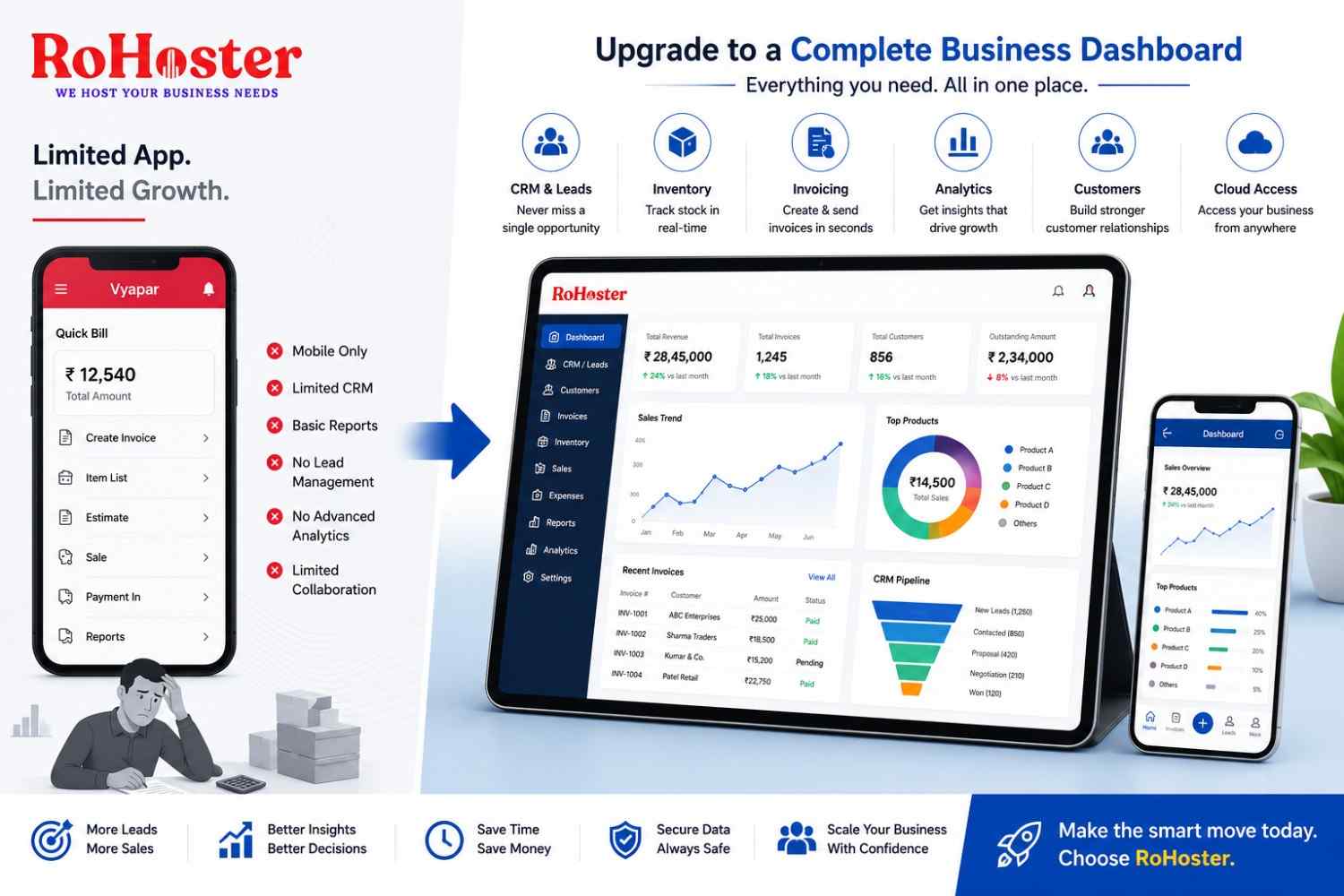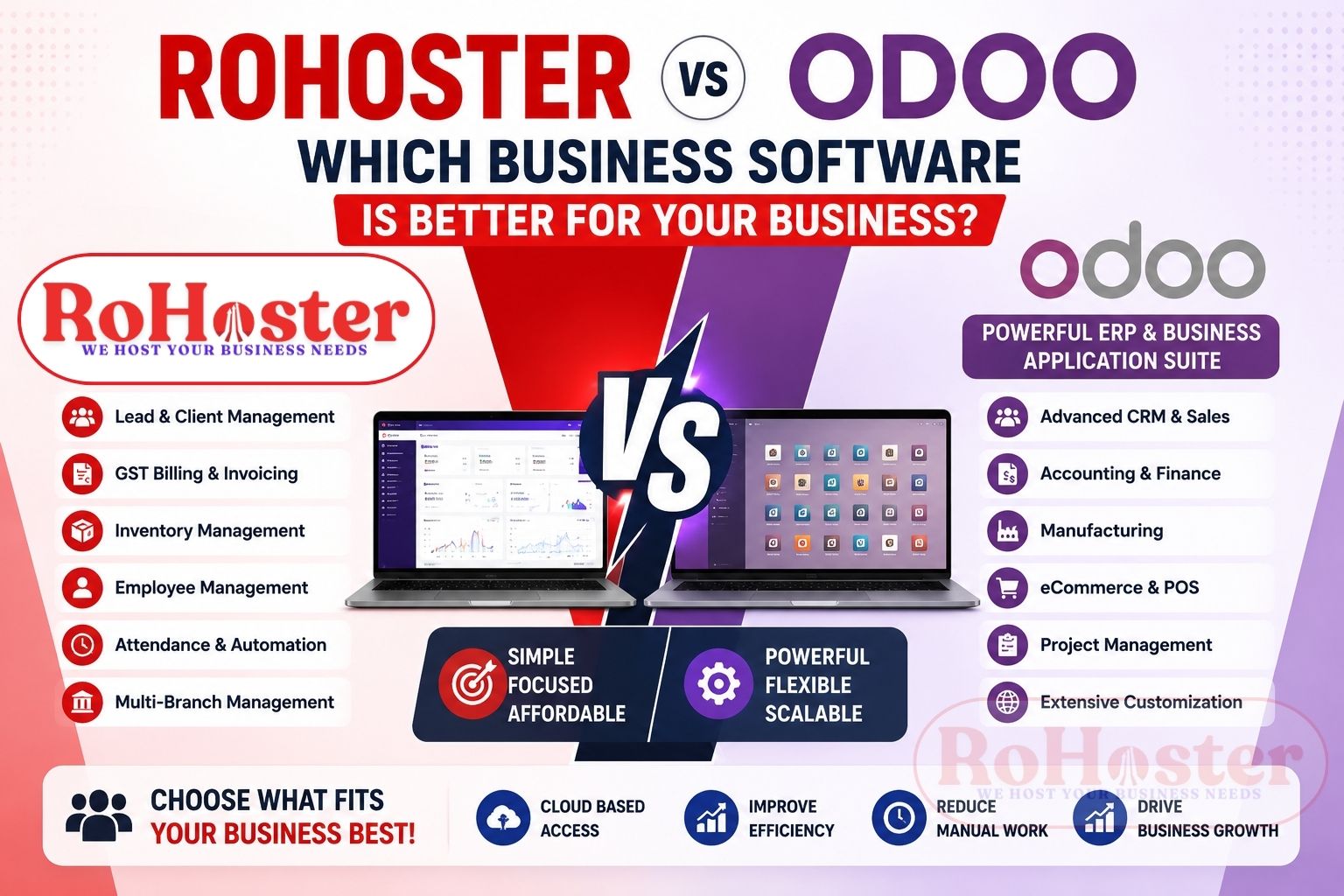
Choosing the right business management software can have a major impact on how efficiently a company manages its sales, customers, billing, inventory, employees, and daily operations.
Two platforms that businesses may consider are RoHoster and Odoo.
Both aim to bring multiple business functions into one platform, but they are designed with different priorities in mind. Odoo is a broad, highly configurable open-source business application suite covering CRM, accounting, inventory, manufacturing, eCommerce, HR, POS, and many other functions.
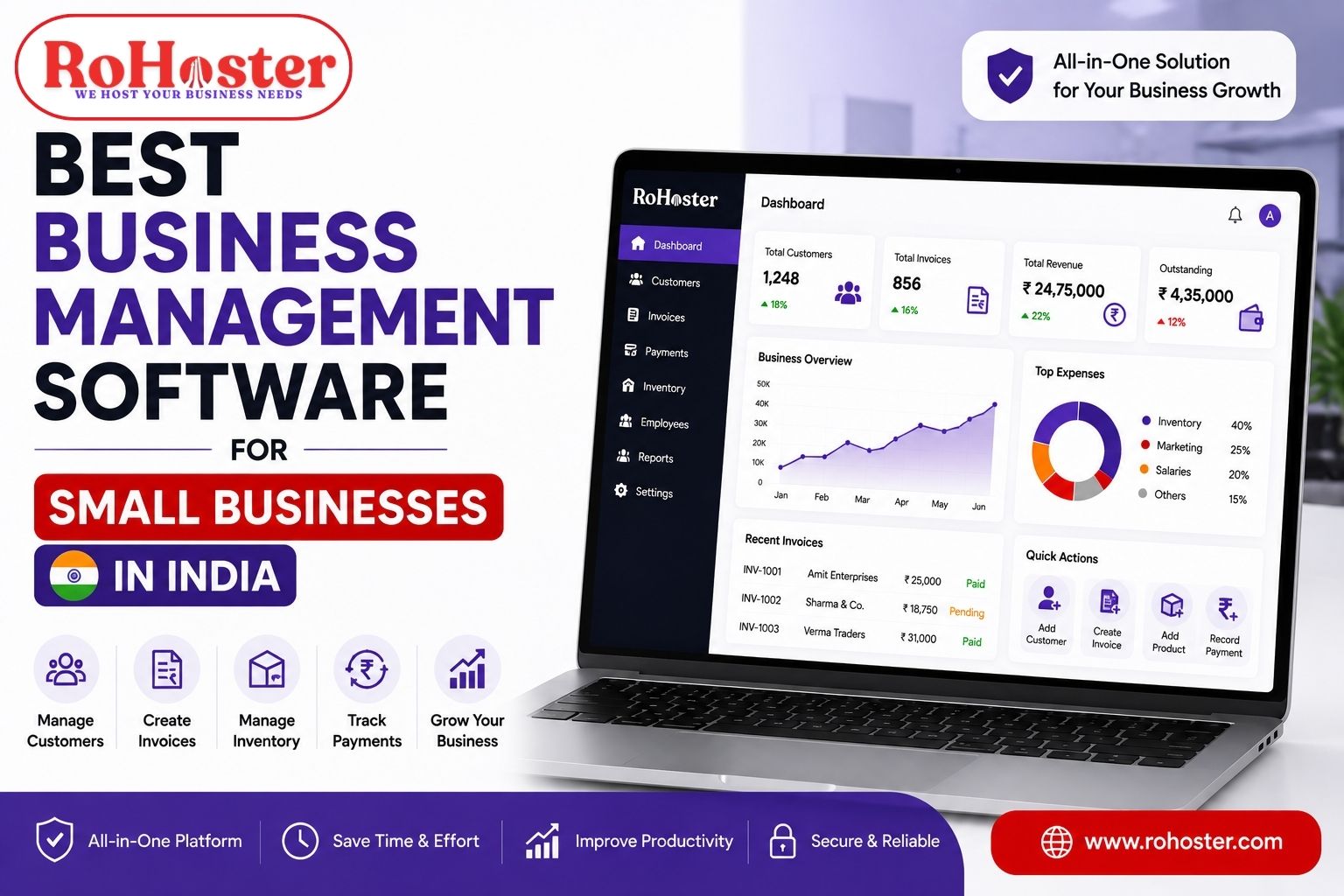
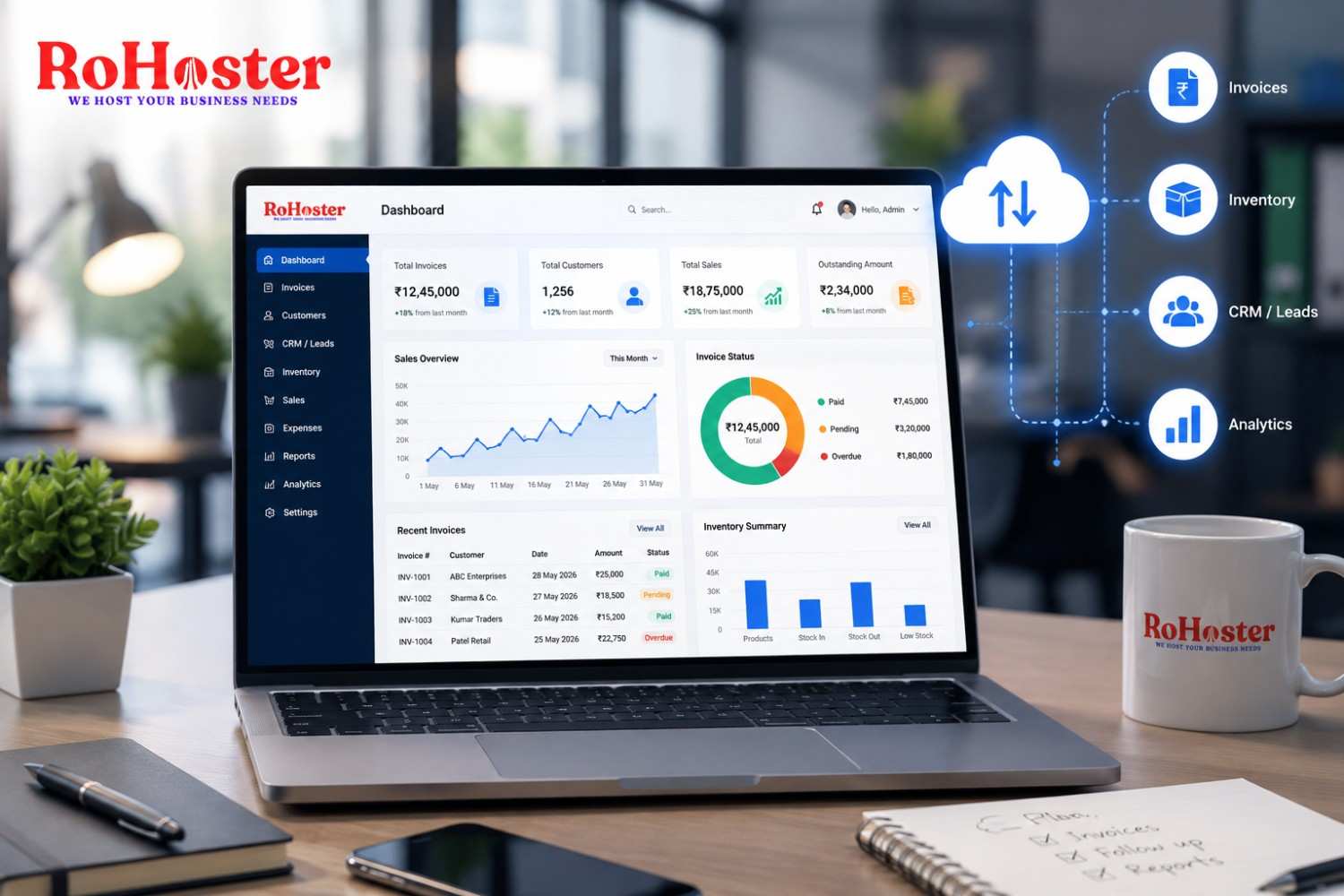
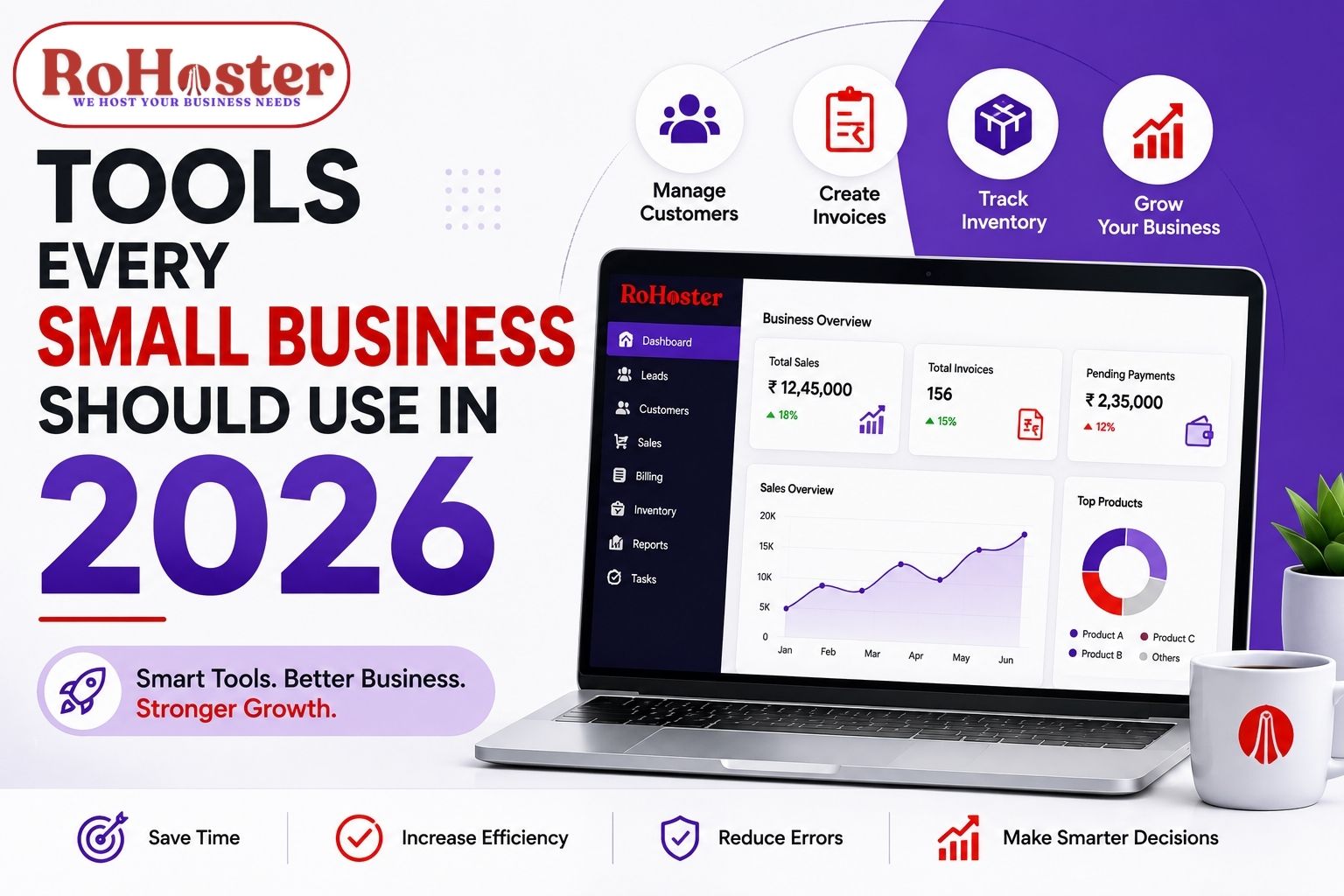
RoHoster, on the other hand, focuses on providing an all-in-one business management platform for Indian SMEs, bringing leads, clients, billing, inventory, employees, attendance, automation, and multi-branch management into one simpler workspace.
So, RoHoster vs Odoo — which one should you choose?
The answer depends largely on the size of your business, complexity of your operations, customization requirements, and the type of software experience your team needs.
RoHoster vs Odoo: Quick Comparison
| Feature | RoHoster | Odoo |
|---|---|---|
| Primary focus | SME business management | Broad ERP & business application suite |
| CRM & Lead Management | ✅ | ✅ |
| Client Management | ✅ | ✅ |
| Billing & Invoicing | ✅ | ✅ |
| Inventory | ✅ | ✅ |
| Employee Management | ✅ | ✅ |
| Attendance | ✅ GPS/Geo-fenced | ✅ |
| Multi-Branch | ✅ | ✅ |
| Automation | ✅ | ✅ |
| Manufacturing | — | ✅ |
| eCommerce | — | ✅ |
| POS | — | ✅ |
| Project Management | — | ✅ |
| Highly customizable ERP | Limited/Focused | ✅ |
| Best suited for | Indian SMEs & growing businesses | Businesses needing broader ERP capabilities |
Odoo officially offers a large suite of applications including CRM, Sales, Accounting, Inventory, HR, Project, POS, Manufacturing, Website and eCommerce.
What Is RoHoster?
RoHoster is an all-in-one business management software designed for growing Indian businesses.
Instead of requiring businesses to use separate tools for different activities, RoHoster brings key business operations into one centralized platform.
Its current feature set includes:
- Lead Management
- Client Management
- Billing & Invoicing
- Inventory Management
- Employee Management
- Geo-location Attendance
- Smart Automation
- Multi-Branch Management
- Reports & Dashboards
RoHoster positions itself specifically around simplifying business management for Indian SMEs and reducing the need to manage multiple disconnected tools.
For example, a business can capture a lead, manage the customer, create an invoice, track inventory and manage employees without moving between several unrelated systems.
What Is Odoo?
Odoo is an open-source business application suite that provides a much broader range of applications.
Its ecosystem includes:
- CRM
- Sales
- Accounting
- Inventory
- HR
- Project Management
- Manufacturing
- eCommerce
- Website
- Point of Sale
- Marketing
- Purchase
- Helpdesk
- Field Service
- Planning
Odoo describes its value proposition around having integrated applications that can cover many different business requirements from one platform.
Its CRM also includes features such as pipeline management, lead assignment, activity scheduling, lead scoring, email integration, reporting and automation.
This makes Odoo particularly attractive to businesses looking for a broader ERP ecosystem rather than only a straightforward SME management system.
RoHoster vs Odoo: Lead Management
Lead management is an important area for businesses that depend on sales enquiries.
RoHoster
RoHoster provides tools to:
- Track leads
- Manage follow-ups
- Schedule meetings
- Convert leads into customers
- Automate reminders
- Maintain customer information
The platform is designed to keep lead and customer management connected with other business operations.
Odoo
Odoo CRM offers a more extensive sales-management environment with:
- Lead generation
- Lead nurturing
- Predictive lead scoring
- Lead assignment
- Pipeline management
- Activity scheduling
- Email integration
- Lead-source tracking
- Reporting
- Lead enrichment
Winner?
Odoo has the advantage when a business needs advanced CRM functionality and sophisticated sales workflows.
RoHoster can be a better fit when the priority is keeping lead management simple while connecting it with billing, inventory, employees and other day-to-day business operations.
RoHoster vs Odoo: Billing & Invoicing
Both platforms support invoicing and business transactions.
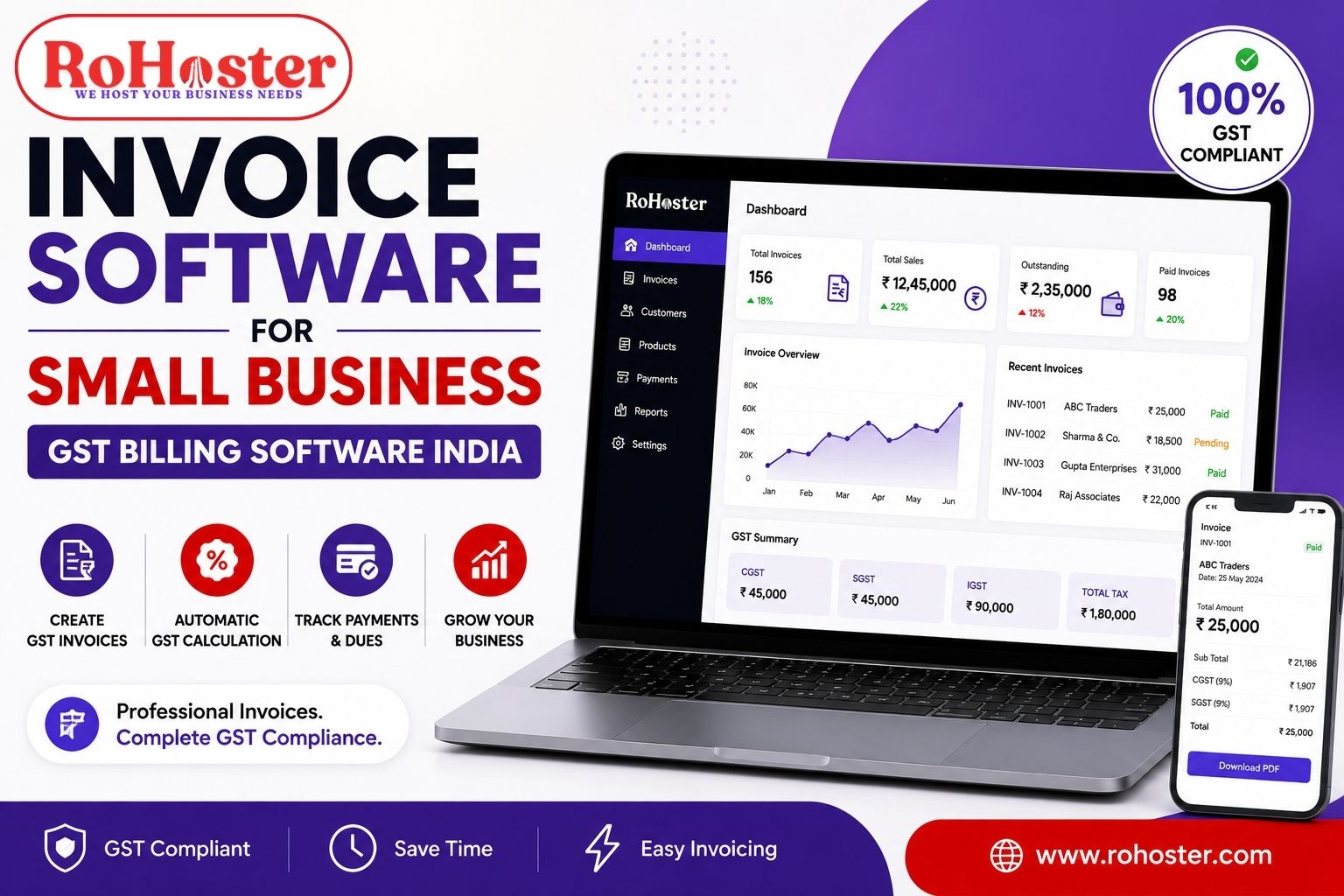
RoHoster focuses on GST-ready invoicing, payment tracking and invoice status as part of its broader SME management platform.
Odoo's Sales and Accounting ecosystem provides a much broader financial and operational environment, including invoicing and accounting-related applications.
Therefore:
For straightforward SME billing and business management: RoHoster can be easier to approach.
For broader accounting and ERP requirements: Odoo offers significantly more depth.
RoHoster vs Odoo: Inventory Management
Inventory management is another area where both platforms can help.
RoHoster provides branch-wise inventory management with stock tracking, reorder alerts and multi-location inventory synchronization.
Odoo offers inventory as part of a much larger ERP ecosystem and can connect inventory with sales, purchase, manufacturing and logistics processes.
For a small retailer, distributor or growing business, RoHoster's focused approach may be sufficient.
For a manufacturer or company with complex procurement, logistics and production requirements, Odoo has a significant advantage.
RoHoster vs Odoo: Employee Management & Attendance
RoHoster includes employee management and GPS-based geo-fenced attendance, allowing businesses to manage teams and attendance across branches.
Odoo has a much broader HR ecosystem covering areas such as employees, recruitment, time off, appraisals and expenses.
So once again, the choice depends on requirements.
If a business wants simple employee and attendance management connected to its business operations, RoHoster can be attractive.
If a company requires a complete HR management ecosystem, Odoo provides more functionality.
RoHoster vs Odoo: Ease of Use
This is one of the biggest differences between the two platforms.
Odoo provides an extremely broad set of applications. That is one of its biggest strengths, but it can also mean that businesses need more configuration and implementation when their requirements become complex.
Odoo itself provides an implementation estimator that considers business requirements, configuration, training, data import and customization.
RoHoster takes a more focused approach.
Its onboarding flow is designed around:
Sign Up → Add Business Data → Track & Automate
The company states that users can configure their business, add leads, clients, inventory and invoices, and start tracking operations from the platform.
For smaller teams that don't have a dedicated IT or ERP implementation team, this simplicity can be an important advantage.
Also Read: RoHoster vs Salesforce: Which CRM & Business Software Is Better?
RoHoster vs Odoo: Customization
This is an area where Odoo is considerably stronger.
Odoo's Custom plan supports customization, multi-company functionality and external API access, while Odoo's ecosystem provides a large number of applications and integrations.
This makes Odoo suitable for businesses with highly specific workflows.
RoHoster's philosophy is different: instead of trying to provide an enormous number of applications, it focuses on the most important operational requirements of SMEs.
Therefore:
Need extensive ERP customization? → Odoo
Need a focused business management platform without excessive complexity? → RoHoster
RoHoster vs Odoo: Pricing
Odoo currently offers:
- One App Free: $0
- Standard: $24.90/user/month when billed annually
- Custom: $49/user/month when billed annually
The Standard and Custom plans provide access to Odoo's applications, with Custom adding features such as customization, multi-company and external API capabilities.
RoHoster is positioned around affordability for Indian SMEs and offers a free entry option, allowing businesses to start without a large upfront software investment.
Because pricing structures and plans can change, businesses should check the current official pricing pages before making a purchase decision.
Which Is Better for Indian SMEs?
This is where the comparison becomes more interesting.
Indian SMEs often need practical tools for:
- Lead management
- Customer management
- GST invoicing
- Inventory
- Employee attendance
- Follow-ups
- Business reporting
- Multiple branches
They may not necessarily need a full ERP system with manufacturing, eCommerce, advanced accounting, project management, POS and dozens of additional modules.
For such businesses, RoHoster's focused approach can be more practical.
The platform is specifically positioned around Indian SMEs and aims to simplify business management by bringing core operations into one system.
When Should You Choose RoHoster?
RoHoster may be a better choice if your business:
- Is a small or growing SME
- Wants simple business management software
- Needs CRM + billing + inventory in one platform
- Wants employee and attendance management
- Operates multiple branches
- Wants cloud-based access
- Wants to minimize the number of software tools
- Doesn't need a complex ERP implementation
Typical users could include:
Retailers, distributors, service businesses, agencies, consultants, startups, professional firms and other growing SMEs.
When Should You Choose Odoo?
Odoo may be the better choice if your business:
- Needs a complete ERP ecosystem
- Has complex business processes
- Requires manufacturing management
- Needs extensive customization
- Requires advanced accounting workflows
- Wants eCommerce and POS integration
- Has dedicated implementation or IT resources
- Needs a large ecosystem of applications and integrations
Odoo's extensive application ecosystem makes it particularly powerful for businesses whose requirements go far beyond basic CRM and business operations.
Also Read: RoHoster vs Zoho CRM: Which CRM Is Better for Indian Businesses?
RoHoster vs Odoo: Pros and Cons
RoHoster — Pros
- Simple and focused
- Designed for Indian SMEs
- CRM + billing + inventory + employee management
- GST-ready invoicing
- Geo-location attendance
- Multi-branch management
- Cloud-based
- Easy onboarding
- Affordable entry point
RoHoster — Cons
- Smaller ecosystem compared with Odoo
- Fewer advanced ERP modules
- Less suitable for complex manufacturing operations
- More limited enterprise-level customization
Odoo — Pros
- Extremely broad application ecosystem
- Advanced CRM capabilities
- Accounting and ERP functionality
- Manufacturing
- eCommerce
- POS
- HR
- Project management
- Extensive customization
- Open-source foundation
Odoo — Cons
- Can be more complex for small businesses
- Implementation can require configuration and training
- Advanced customization may require additional technical expertise
- The breadth of features may be unnecessary for businesses with simpler requirements
RoHoster vs Odoo: Final Verdict
There is no universal winner between RoHoster and Odoo.
They solve similar business-management problems from different perspectives.
Odoo is better suited for businesses looking for a powerful, broad and highly configurable ERP ecosystem.
RoHoster is better suited for businesses looking for a simple, affordable and focused all-in-one business management platform for Indian SMEs.
The decision should therefore depend on your business requirements.
If you need manufacturing, advanced ERP workflows, extensive customization and a large ecosystem, Odoo is worth considering.
If your priority is to manage leads, clients, billing, inventory, employees, attendance and daily business operations from one simple platform, RoHoster offers a more focused alternative.
Ultimately, the best business management software is not the one with the most features.
It is the one that gives your team the right features without unnecessary complexity.