Choosing the right business software becomes increasingly important as a company grows.
A small business may initially manage leads in Excel, communicate with customers through WhatsApp, maintain invoices separately, and keep employee or inventory records in different files. But as the number of customers, leads, employees, and transactions increases, these disconnected processes can become difficult to manage.
This is where CRM and business management software can help.
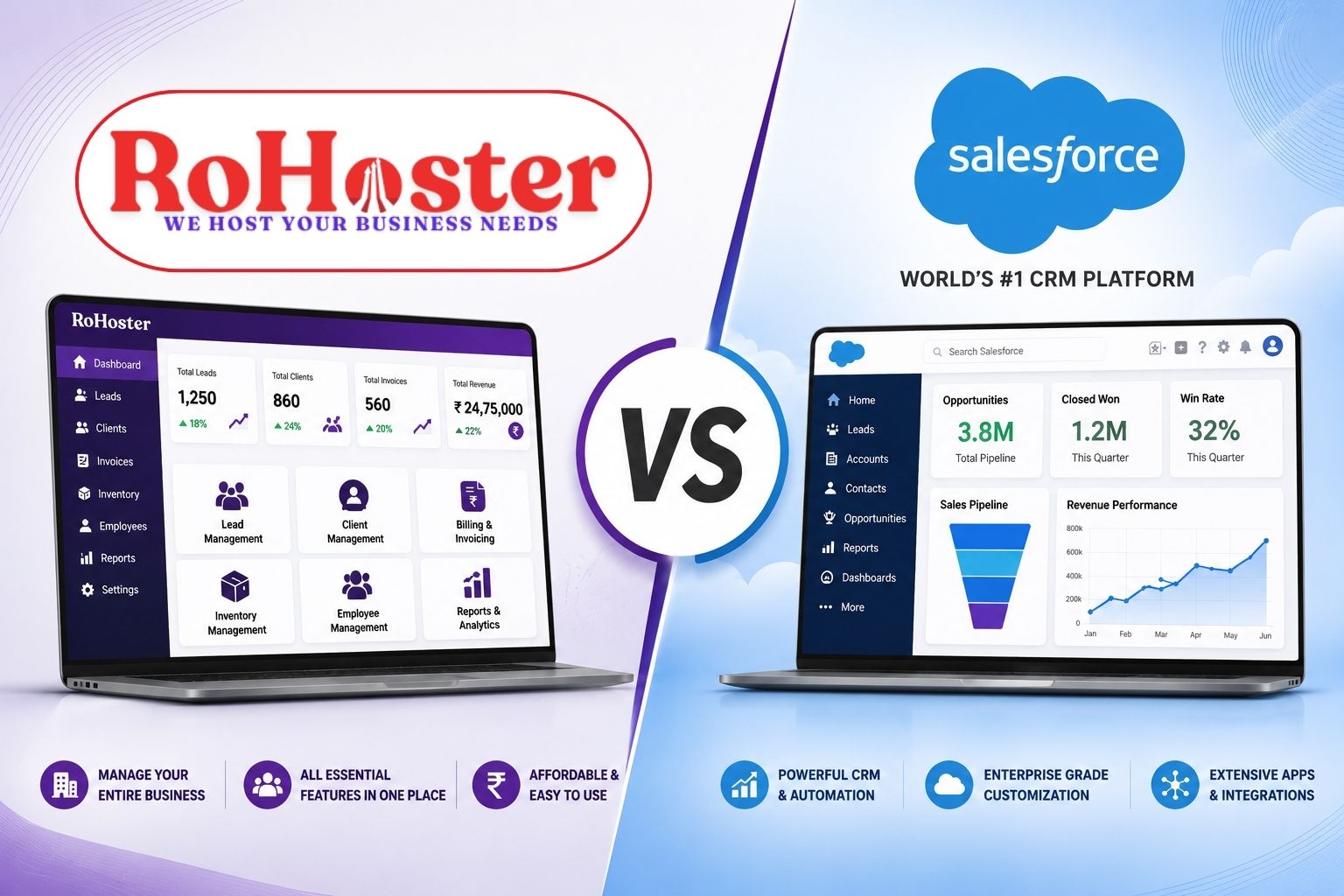
Two platforms that businesses may consider are RoHoster and Salesforce. However, they are built with somewhat different priorities.
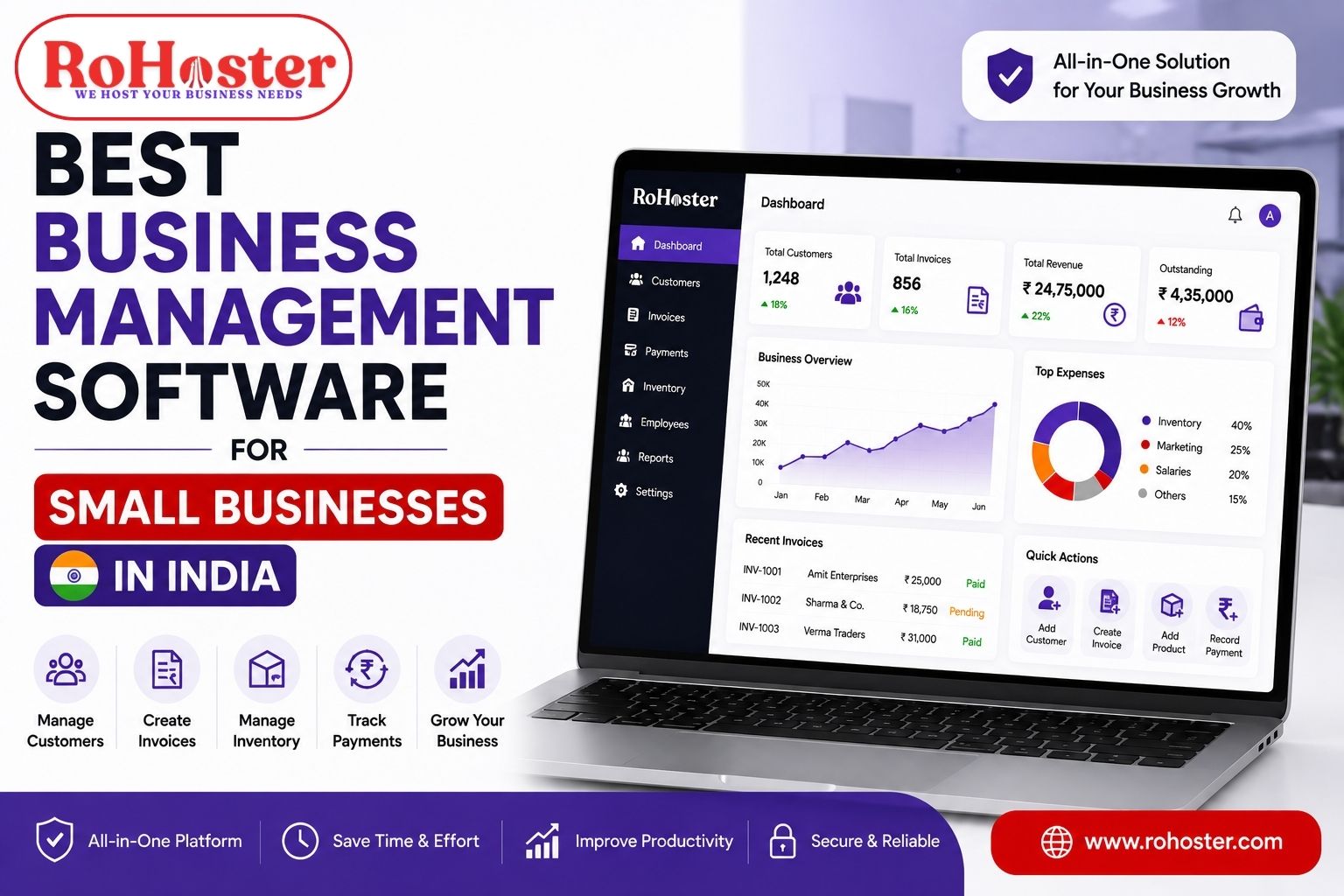
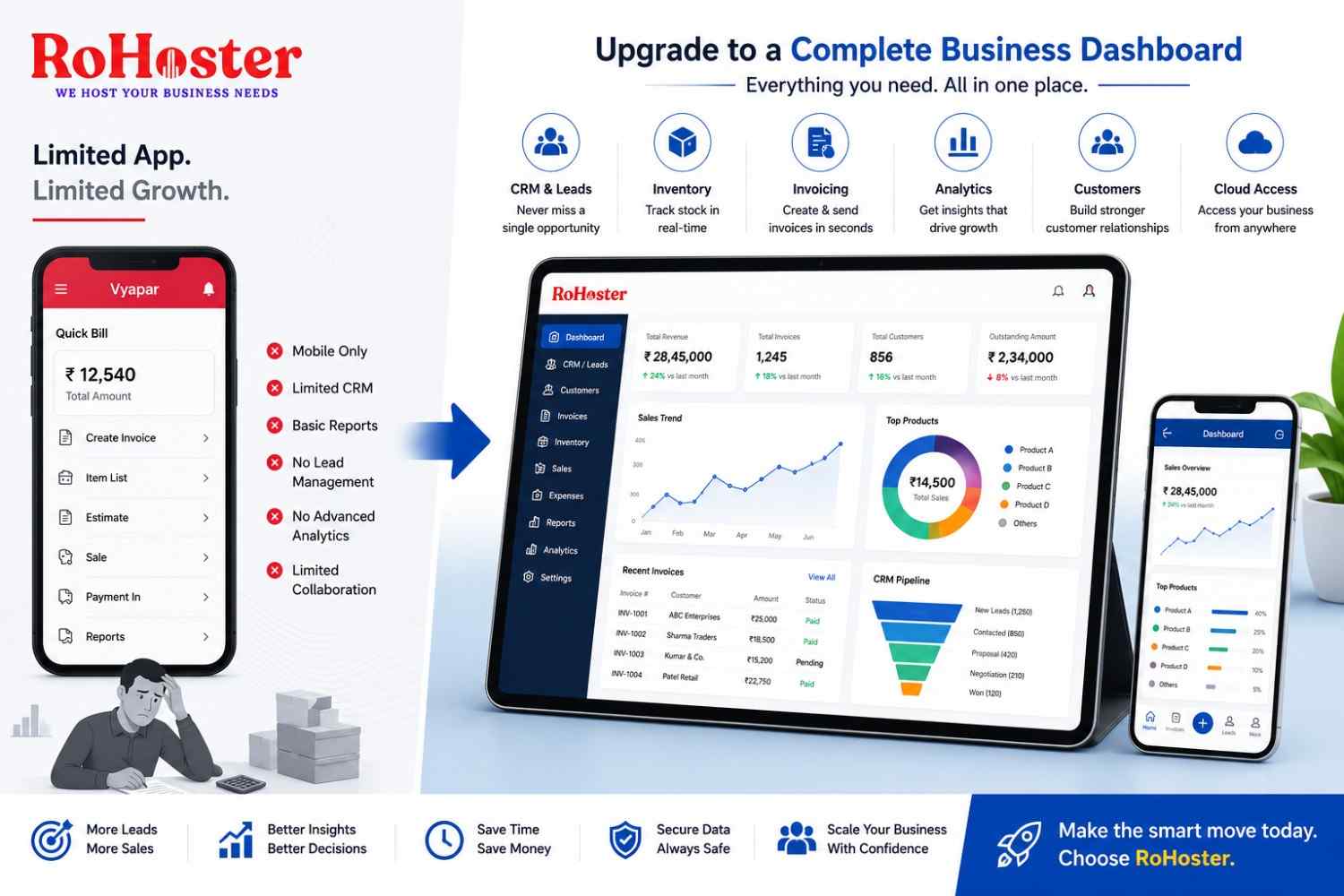
RoHoster positions itself as an all-in-one business management platform for growing Indian businesses, bringing leads, clients, billing, inventory, employees, attendance, and business operations into one workspace.
Salesforce, meanwhile, is a mature and highly configurable CRM ecosystem focused heavily on sales, customer relationships, service, marketing, automation, analytics, integrations, and AI. Salesforce offers different editions and suites designed for businesses ranging from small teams to large enterprises.
So, when comparing RoHoster vs Salesforce, the question isn't simply which platform has more features.
The better question is:
Which platform is better suited to your business requirements?
RoHoster vs Salesforce: Quick Comparison
| Feature | RoHoster | Salesforce |
|---|---|---|
| Lead Management | ✓ | ✓ |
| Client Management | ✓ | ✓ |
| Follow-Up Management | ✓ | ✓ |
| Sales Pipeline | ✓ | ✓ |
| Billing & Invoicing | ✓ | Available through broader ecosystem |
| Inventory Management | ✓ | Available in selected CRM editions/ecosystem |
| Employee Management | ✓ | Primarily CRM-focused |
| Attendance Management | ✓ | Not a core CRM function |
| Multi-Company / Branch Operations | ✓ | Requires configuration/ecosystem |
| Business Management | Core focus | Primarily CRM/customer operations |
| Advanced CRM Customization | Growing | Extensive |
| Sales Automation | ✓ | Advanced |
| AI & Automation | Evolving | Extensive |
| Integrations | Available | Extensive ecosystem |
| Best suited for | Indian SMEs wanting an integrated business platform | Businesses needing a highly configurable CRM ecosystem |
Salesforce currently offers CRM suites with lead, account, contact and opportunity management, sales flows, routing, analytics and AI features; higher editions add greater customization, automation, forecasting, APIs and advanced AI capabilities.
What Is RoHoster?
RoHoster is an all-in-one business management software designed around the needs of growing businesses.
Instead of focusing only on customer relationship management, RoHoster brings multiple business functions together.
Its platform includes areas such as:
- Lead Management
- Client Management
- Follow-Up Management
- Billing & Invoicing
- Inventory Management
- Employee Management
- Attendance
- Multi-Company / Branch Management
- Business Reports
RoHoster describes its platform as a workspace where businesses can bring leads, clients, billing, inventory and teams together.
The basic philosophy is:
One platform. Multiple business operations.
This approach is particularly relevant for small and medium-sized businesses that don't want to manage a separate application for every operational requirement.
What Is Salesforce?
Salesforce is one of the world's best-known CRM platforms.
It is primarily designed around managing customer relationships and sales processes, but its broader ecosystem extends into:
- Sales
- Customer Service
- Marketing
- Commerce
- Analytics
- Collaboration
- Automation
- AI
- Integrations
Salesforce describes its CRM as a scalable and customizable platform that can serve businesses of different sizes and industries. Its different editions progressively add automation, customization, integrations and advanced capabilities.
For businesses with complex sales processes, Salesforce can provide a very deep CRM environment.
Also Read: RoHoster vs Zoho CRM: Which CRM Is Better for Indian Businesses?
RoHoster vs Salesforce: The Biggest Difference
The biggest difference is positioning.
RoHoster
Business Management First
Leads + Clients + Billing + Inventory + Employees + Operations
Salesforce
CRM & Customer Operations First
Leads + Accounts + Contacts + Opportunities + Sales + Service + Marketing + Automation
This doesn't mean Salesforce cannot support broader business processes. Salesforce has a large ecosystem and integrations that can extend its capabilities.
The distinction is that RoHoster's core proposition is to bring multiple everyday business operations together in one platform, while Salesforce's core strength is a sophisticated CRM ecosystem.
1. Lead Management
Both platforms can help businesses manage leads.
RoHoster provides lead management as one component of its broader business management platform. Businesses can track prospects, manage follow-ups, schedule activities, and move leads toward conversion.
Salesforce provides a much deeper CRM environment for lead and opportunity management.
Its current Starter Suite includes lead, account, contact and opportunity management, lead routing and sales flows, while higher editions add more advanced automation and pipeline capabilities.
Which is better?
For straightforward lead management integrated with other business operations, RoHoster may be a natural fit for an SME.
For complex sales processes, advanced automation and sophisticated CRM workflows, Salesforce has greater depth.
2. Customer & Client Management
Customer information is central to both platforms.
RoHoster allows businesses to maintain client records along with service and transaction-related information. Its objective is to keep customer information connected with other business activities.
Salesforce provides highly detailed account and contact management, with customer interactions, opportunities, activities and other CRM information available through its platform.
This makes Salesforce particularly powerful for businesses where customer relationship management is the central operational requirement.
Simple difference:
RoHoster: Customer management as part of overall business management.
Salesforce: Deep customer relationship management as a core platform capability.
3. Sales Pipeline Management
Sales pipeline management helps businesses understand where every potential deal currently stands.
For example:
New Lead → Contacted → Qualified → Proposal → Negotiation → Won
RoHoster provides sales and lead management functionality as part of its broader business-management approach.
Salesforce offers extensive pipeline management and sales automation, with more advanced pipeline and forecasting capabilities available in higher editions.
For a small business with a straightforward sales process, a simpler system may be sufficient.
For companies with complex sales teams, multiple sales stages, forecasting requirements, and sophisticated automation, Salesforce can offer considerably more depth.
4. Follow-Up Management
Follow-ups are critical for sales.
A potential customer may ask your team to call them tomorrow, next week, or after receiving a quotation.
If these activities are managed manually, opportunities can easily be missed.
RoHoster includes lead and follow-up management as part of its business-management platform.
Salesforce provides much more extensive sales automation and AI capabilities that can help sales teams manage activities and customer engagement. Its small-business offering also promotes AI-assisted lead follow-up and pipeline management.
For SMEs:
If your primary requirement is simply:
"Make sure my team doesn't forget follow-ups."
a straightforward CRM workflow may be enough.
If you need sophisticated automated sales engagement, Salesforce has greater depth.
5. Billing and Invoicing
This is one area where the two platforms have different approaches.
RoHoster includes invoice management as a core business-management feature.
Salesforce's primary product is not an accounting or invoicing platform. Businesses requiring broader financial or operational functionality may use Salesforce alongside other applications or integrations.
This difference can be important for Indian SMEs.
If your business wants:
Lead → Customer → Invoice → Payment → Inventory
within a broader business-management workflow, an integrated platform can be attractive.
If CRM and sales are the primary concern, Salesforce's extensive ecosystem may be more relevant.
6. Inventory Management
Inventory is another important consideration for Indian SMEs.
RoHoster includes inventory management as part of its core business-management platform.
Salesforce also supports inventory-related functionality in selected editions and through its wider ecosystem. Its current CRM pricing information, for example, lists inventory management among Professional-level capabilities.
However, businesses should evaluate not just whether inventory functionality exists, but how deeply it connects with:
- Customers
- Sales
- Billing
- Products
- Branches
- Business reports
This is especially important for traders, distributors, retailers and manufacturers.
7. Employee and Attendance Management
This is a significant difference.
RoHoster includes employee management and attendance within its broader business-management offering.
Salesforce CRM is primarily focused on customers, sales and related business processes.
Businesses needing employee-focused capabilities in the Salesforce ecosystem may need additional Salesforce products, integrations or external systems.
Therefore, if you want one system to cover both:
Customer-facing operations + internal business operations
an all-in-one business management platform can be more convenient.
8. Customization
This is an area where Salesforce has a major advantage.
Salesforce is designed for organizations with complex and specialized workflows.
Its different editions provide progressively greater:
- Customization
- Automation
- APIs
- Workflow management
- Custom processes
- Integrations
- Analytics
- AI capabilities
Salesforce itself notes that its higher tiers are designed for larger teams and more complex workflows, with greater customization and automation.
RoHoster's approach is comparatively simpler: provide the core tools growing businesses need in one platform.
Therefore:
Need extensive CRM customization? → Salesforce
Need a simpler integrated business-management system? → RoHoster
9. Integrations
Salesforce has a major advantage when it comes to integrations and ecosystem depth.
Salesforce promotes a large ecosystem of applications and integrations, and its higher-level CRM offerings provide APIs and broader integration capabilities.
This is particularly valuable for companies already using multiple enterprise applications.
RoHoster's approach is different.
Rather than requiring businesses to connect numerous applications for basic operations, the platform aims to provide several core business functions within the same system.
For a small business, reducing the number of tools can itself be an advantage.
10. Ease of Use
A powerful system is only useful if your team actually uses it.
Salesforce offers enormous flexibility, but organizations with complex requirements may need more configuration, implementation, training, or specialist support.
Salesforce itself recommends considering onboarding, support, future scalability, team requirements, and training when selecting and implementing a CRM.
RoHoster takes a more straightforward approach by combining essential business functions into one platform.
For a small team that wants to get started without building a complicated CRM architecture, simplicity can be an important advantage.
11. Scalability
Both platforms can support growing businesses, but they approach scalability differently.
Salesforce is designed to scale from small businesses to complex organizations and provides progressively more powerful editions as requirements increase.
RoHoster focuses on growing SMEs that need to move from spreadsheets and disconnected tools toward a more structured business-management system.
The choice depends on the type of growth you expect.
If your business is growing in CRM complexity:
Salesforce may be the stronger long-term choice.
If your business is growing in operational complexity:
An all-in-one business management platform may be more practical.
12. Pricing and Total Cost
Pricing should be evaluated carefully because comparing only the starting subscription price can be misleading.
Salesforce's current Sales pricing lists:
- Starter Suite: $25/user/month
- Pro Suite: $100/user/month
- Enterprise: $175/user/month
- Unlimited: $350/user/month
- Agentforce 1 Sales: $550/user/month
with billing and edition conditions varying by plan.
Salesforce also offers a free suite for getting started, according to its current small-business offering.
Also Checkout RoHoster's Pricing
However, businesses should consider the total cost of ownership, including:
- Number of users
- Required edition
- Add-ons
- Integrations
- Implementation
- Customization
- Training
- Support
- Additional business applications
For a small Indian business, the question should therefore not simply be:
"Which software has the lowest monthly price?"
Instead:
"Which platform gives us the functionality we need without paying for complexity we don't need?"
RoHoster vs Salesforce: Who Should Choose What?
Choose RoHoster If:
You are a small or medium-sized business looking for:
- Lead management
- Client management
- Follow-up tracking
- Billing and invoicing
- Inventory management
- Employee management
- Attendance
- Multi-company/branch operations
- Business reporting
- One centralized business platform
RoHoster is particularly positioned around the needs of growing Indian businesses and aims to replace the complexity of managing multiple disconnected tools.
Choose Salesforce If:
Your business requires:
- Advanced CRM capabilities
- Complex sales processes
- Sophisticated sales automation
- Extensive customization
- Advanced analytics
- Large-scale integrations
- AI-powered CRM functionality
- Enterprise-level scalability
- A broad CRM ecosystem
Salesforce's current product range is built to support increasingly complex workflows and adds automation, customization, AI and analytics capabilities as organizations move up its editions.
RoHoster vs Salesforce: A Practical Example
Imagine a growing Indian distributor with:
- 10 employees
- 500+ customers
- Hundreds of leads
- Regular follow-ups
- Product inventory
- Monthly invoicing
- Multiple salespeople
The business may want to manage:
Leads → Customers → Sales → Invoices → Inventory → Employees
If the primary goal is to manage these operational activities through one system, an all-in-one platform such as RoHoster can be a natural fit.
Now imagine a large B2B organization with:
- Multiple sales teams
- Complex sales territories
- Sophisticated forecasting
- Multiple customer service teams
- Advanced automation
- Complex integrations
- Dedicated CRM administrators
That organization may benefit more from Salesforce's deeper CRM ecosystem.
The point is not that one platform is universally better.
The point is that different businesses have different software requirements.
RoHoster vs Salesforce: The Simple Difference
If we reduce the entire comparison to one statement:
RoHoster = Manage Your Business
Salesforce = Manage & Scale Your Customer Relationships
RoHoster's proposition is broader operational management for growing SMEs.
Salesforce's strength is a highly configurable CRM ecosystem that can support sophisticated customer-facing operations at scale.
Is RoHoster a Salesforce Alternative?
Yes—but with an important qualification.
RoHoster can be considered a Salesforce alternative for businesses that do not need the depth and complexity of an enterprise-grade CRM ecosystem and instead want an integrated platform for everyday business management.
It is particularly relevant for SMEs that want to manage:
Leads + Clients + Billing + Inventory + Employees
without assembling multiple systems.
However, businesses that require highly advanced CRM customization, complex enterprise integrations, sophisticated sales automation, or large-scale AI/analytics capabilities may find Salesforce more appropriate.
The right alternative depends on the business's actual requirements.
Final Verdict: RoHoster vs Salesforce
There is no single winner for every business.
Salesforce is the stronger choice for:
Advanced CRM + Automation + Customization + Enterprise Scale
RoHoster is the stronger fit for:
SME Business Management + CRM + Billing + Inventory + Employee Operations
Salesforce has significant advantages in CRM depth, customization, automation, integrations and enterprise scalability.
RoHoster differentiates itself by bringing customer management together with operational functions such as billing, inventory, employees and attendance in a platform designed for growing Indian businesses.
So before choosing between RoHoster and Salesforce, ask one simple question:
Do you need a powerful CRM system—or do you need one system to manage your business?
If your business is primarily looking to build a sophisticated sales and customer-management operation, Salesforce is worth considering.
If your business wants to manage leads, clients, billing, inventory and teams from one centralized platform, RoHoster may be the more practical choice.
Ultimately, the best business software is not the one with the longest feature list.
It is the one that fits your business, your team, your budget, and the way you actually work.