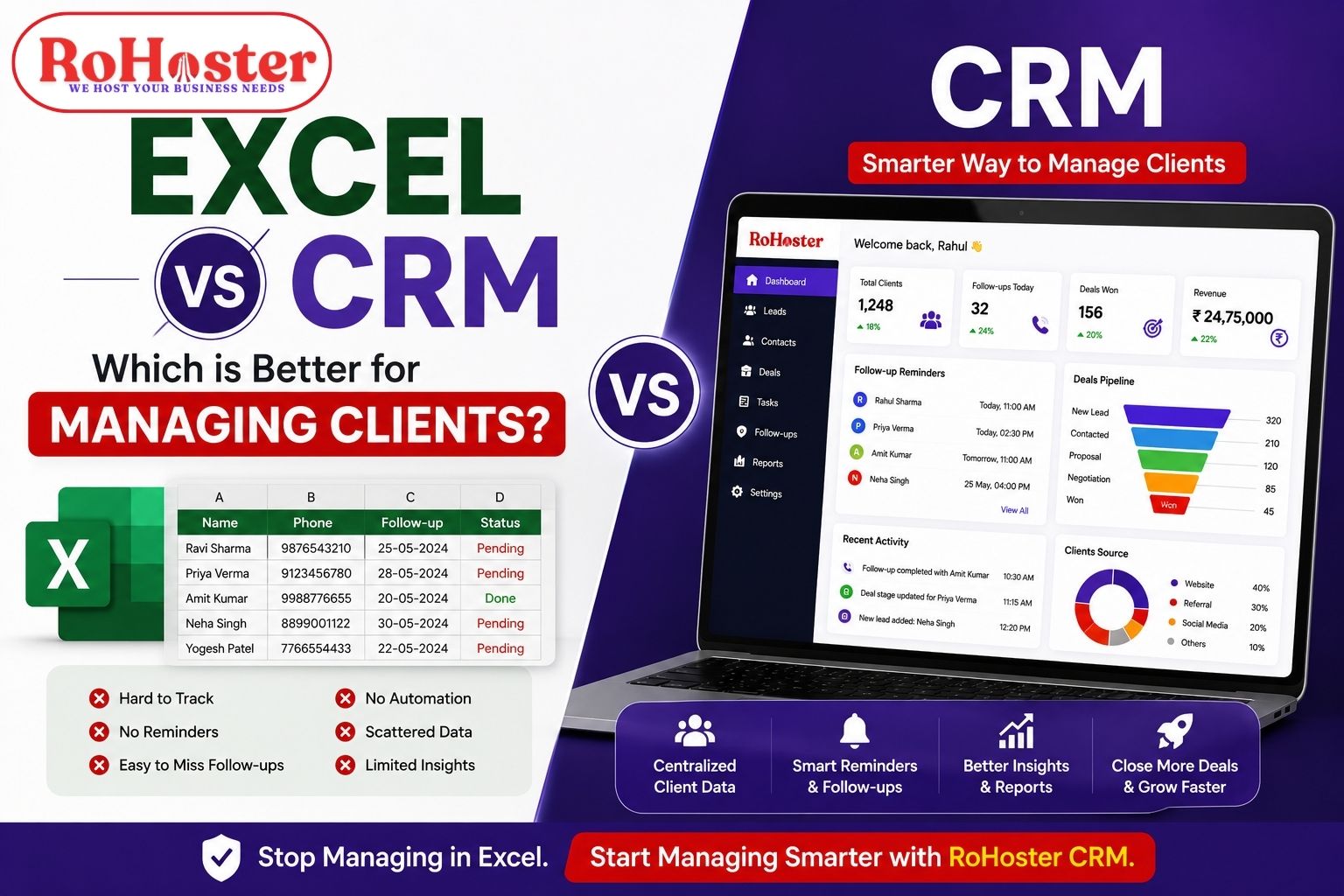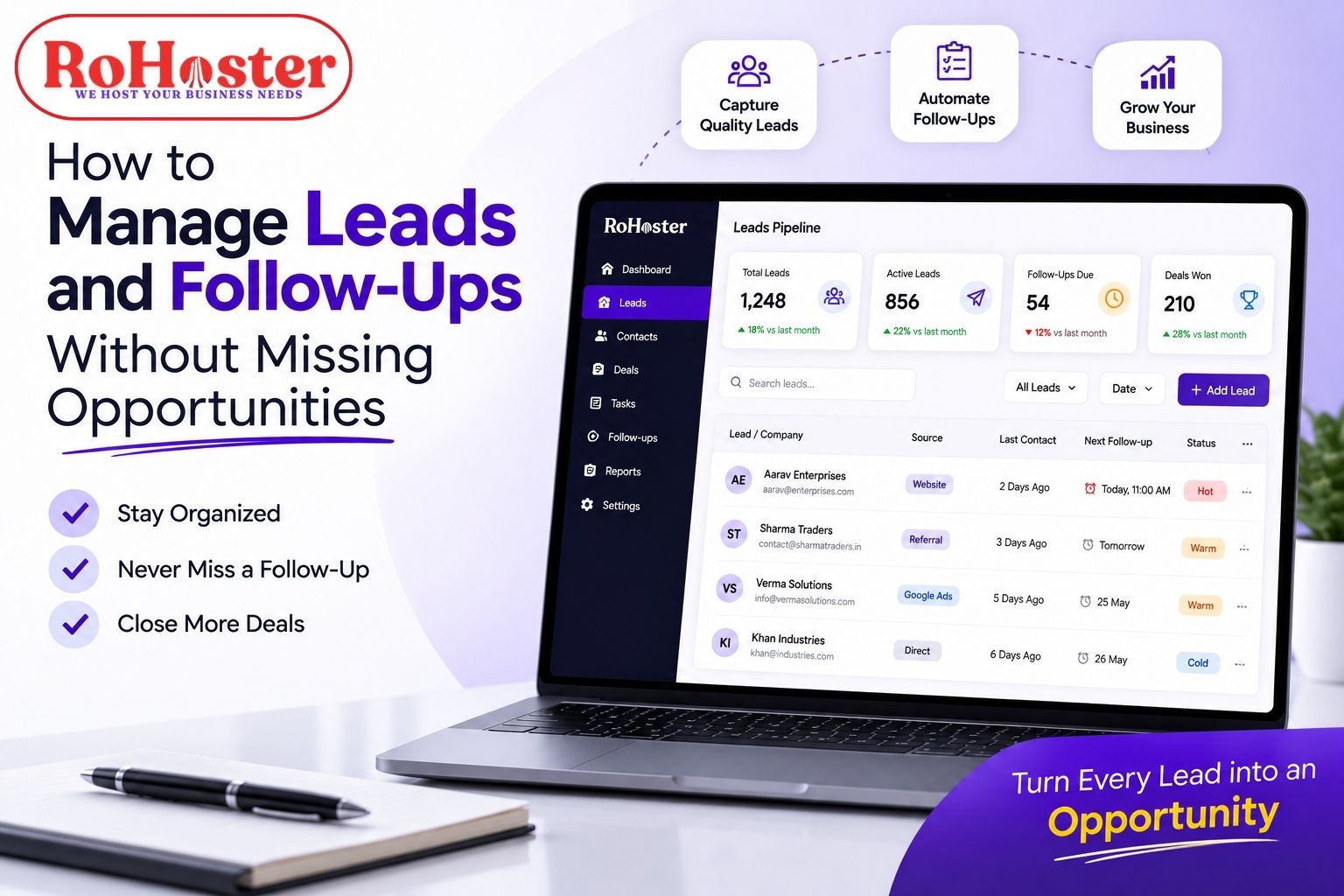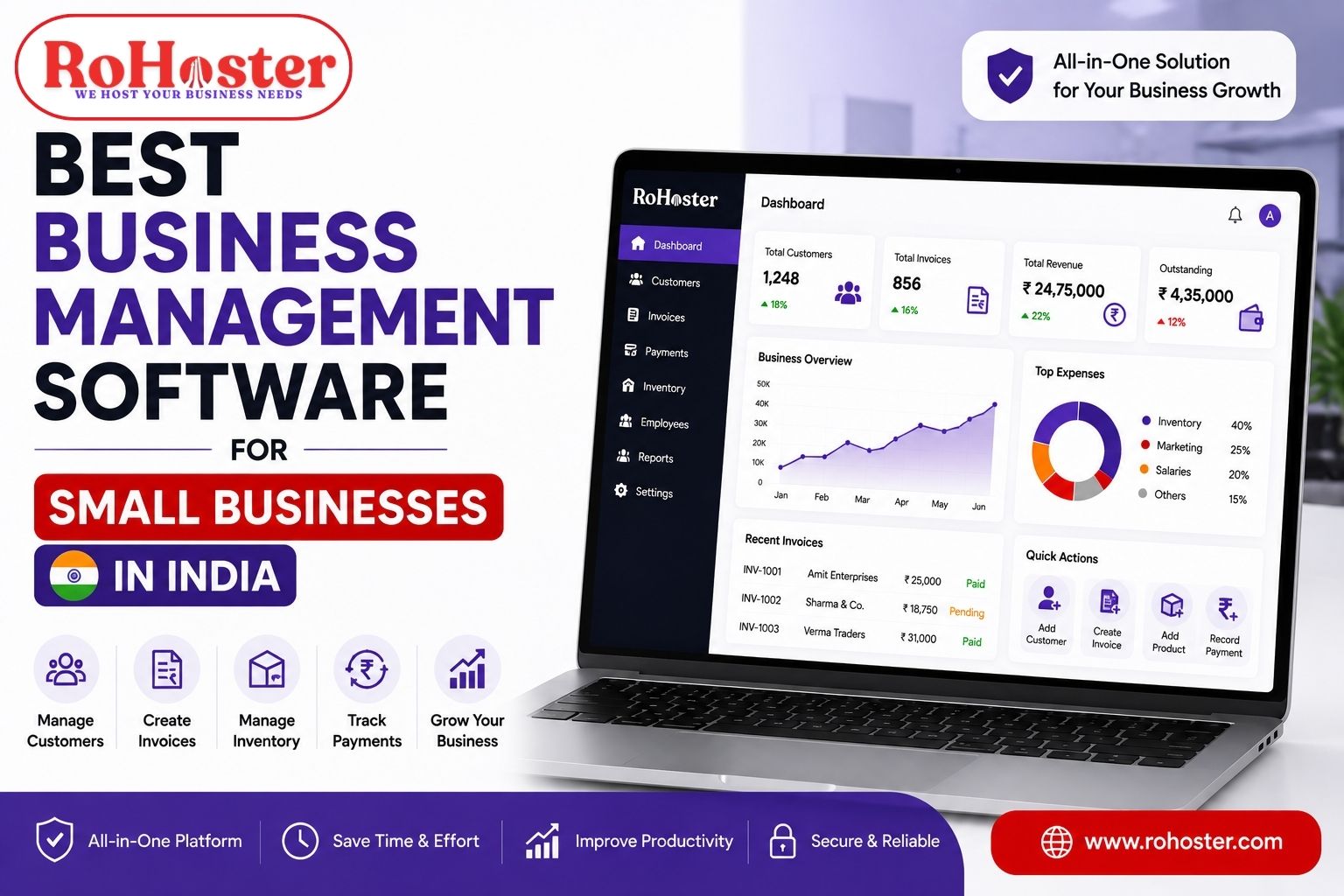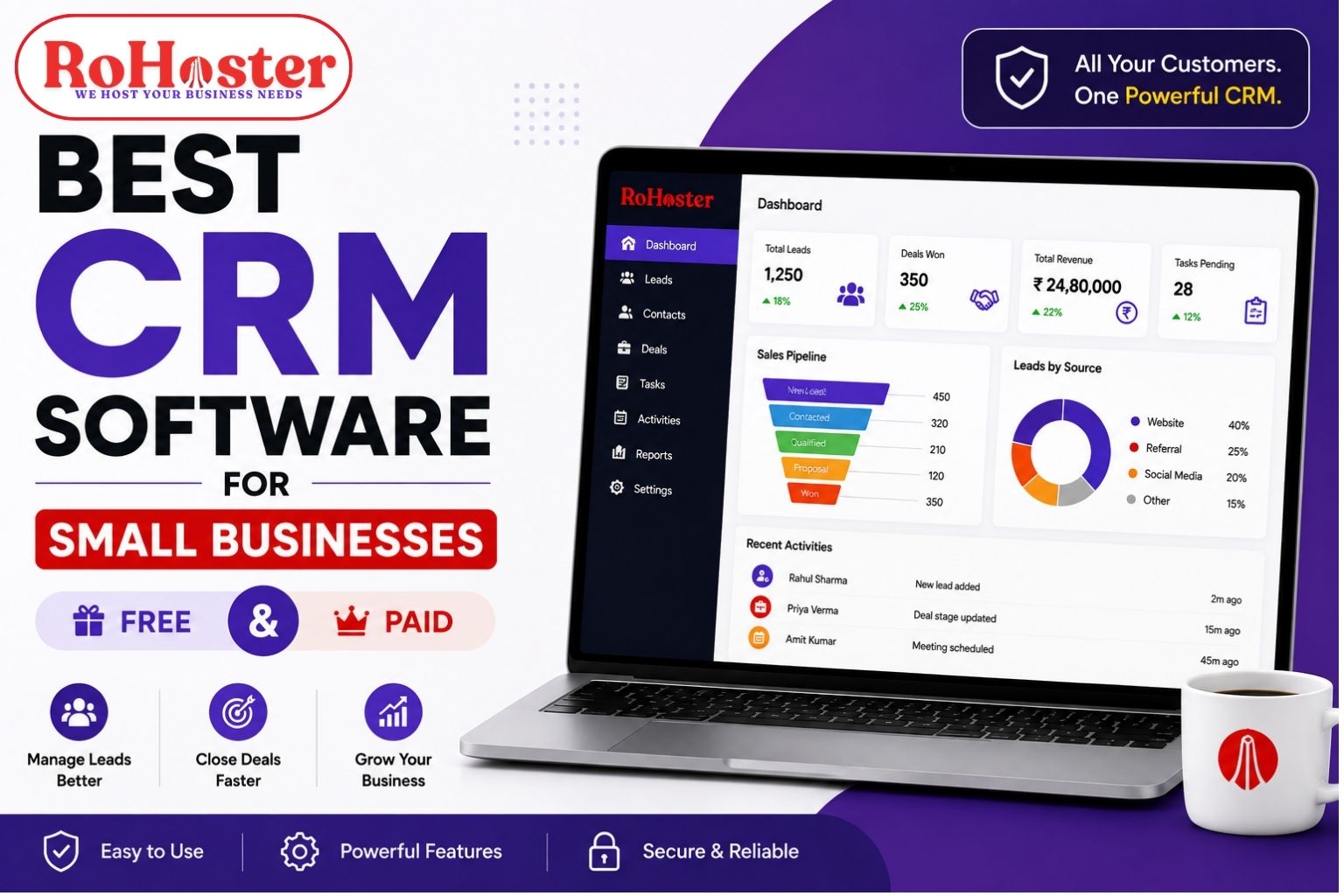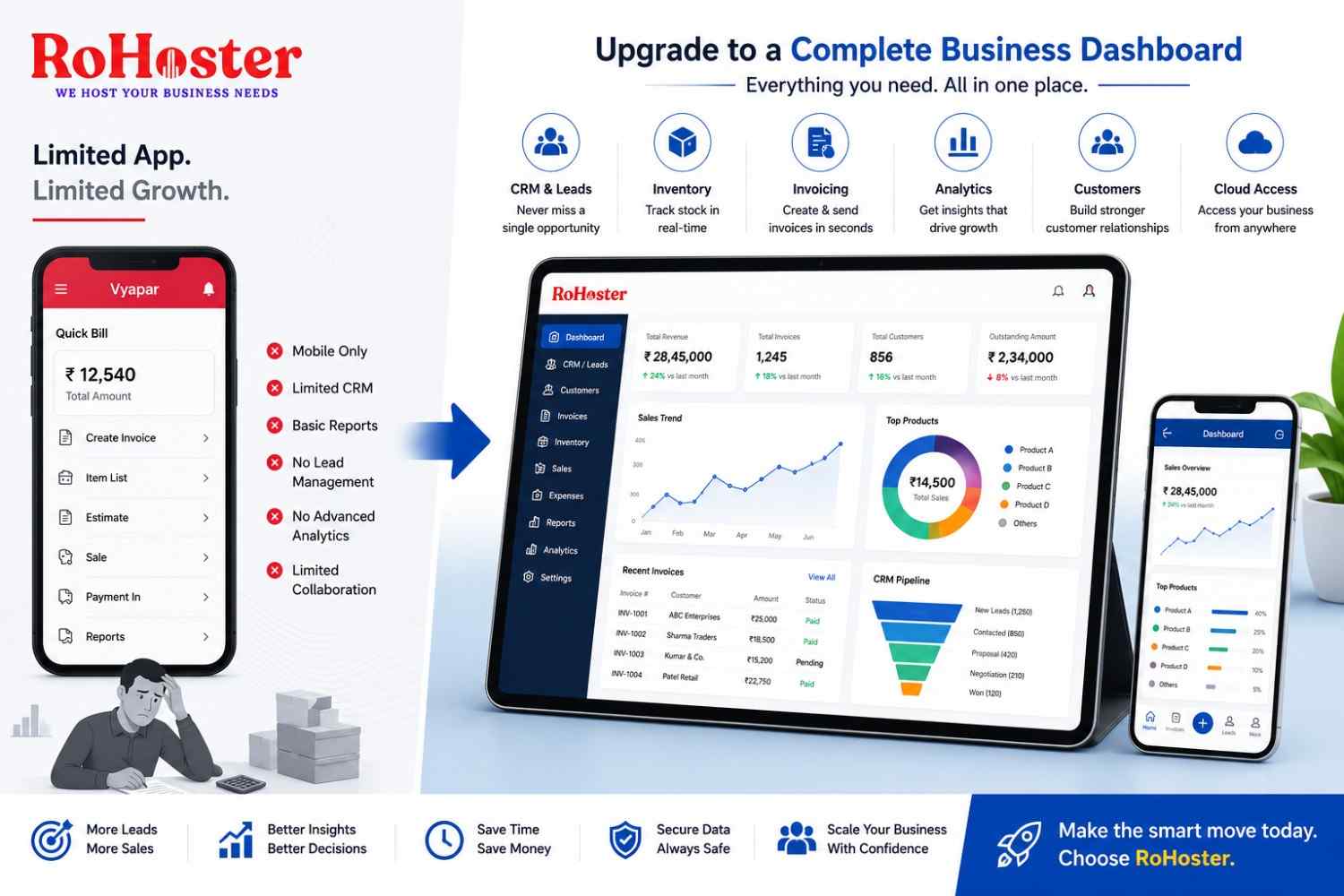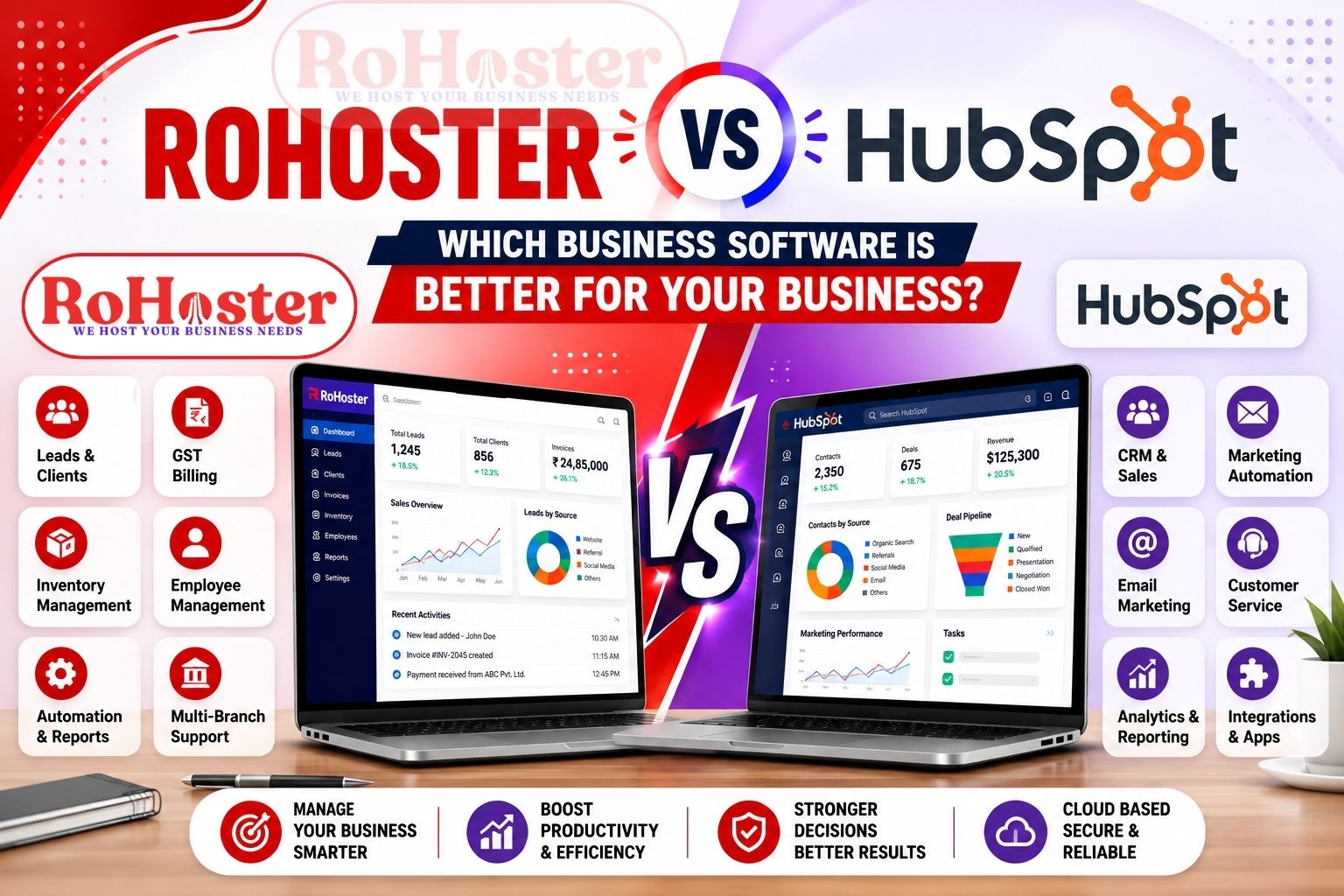
Choosing the right business software can have a direct impact on how efficiently a company manages leads, customers, sales, billing, employees, and everyday operations.
Two platforms that often come into consideration are RoHoster and HubSpot.
At first glance, they may appear similar because both provide tools for lead management, customer relationship management, sales tracking, automation, and reporting. However, their core focus is different.
HubSpot is primarily a customer platform built around CRM, marketing, sales, customer service, content, data, and revenue operations. Its current platform includes Smart CRM along with Marketing Hub, Sales Hub, Service Hub, Content Hub, Data Hub, Revenue Hub, and Agent Hub.
RoHoster is positioned as an all-in-one business management platform for growing Indian businesses, bringing leads, clients, billing, inventory, employees, attendance, automation, and multi-branch operations into one workspace.
So, RoHoster vs HubSpot — which one is better?
The answer depends on what your business actually needs.
RoHoster vs HubSpot: Quick Comparison
| Feature | RoHoster | HubSpot |
|---|---|---|
| Lead Management | ✅ | ✅ |
| Client/Contact Management | ✅ | ✅ |
| Sales Pipeline | ✅ | ✅ |
| Follow-up Management | ✅ | ✅ |
| Automation | ✅ | ✅ |
| Billing & Invoicing | ✅ | ✅* |
| GST-focused Invoicing | ✅ | — |
| Inventory Management | ✅ | — |
| Employee Management | ✅ | — |
| Attendance Management | ✅ | — |
| Multi-Branch Operations | ✅ | — |
| Marketing Automation | — | ✅ |
| Email Marketing | — | ✅ |
| Content Management | — | ✅ |
| Customer Service Tools | — | ✅ |
| Advanced CRM | — | ✅ |
| AI-powered CRM features | — | ✅ |
| Extensive Integrations | — | ✅ |
| Best suited for | Indian SMEs & growing businesses | Marketing, sales & customer-centric teams |
*HubSpot's current platform includes Revenue Hub features for quotes, payments, billing and subscriptions, but its overall product architecture remains centered on the customer journey rather than being an SME ERP/business-operations suite.
What Is RoHoster?
RoHoster is an all-in-one business management software designed for growing Indian businesses.
The platform is built around the idea that SMEs shouldn't need to manage their business through a collection of disconnected applications.
RoHoster brings together:
- Lead Management
- Client Management
- Billing & Invoicing
- Inventory Management
- Employee Management
- Geo-location Attendance
- Smart Automation
- Multi-Branch Management
- Reports & Business Insights
The core idea is straightforward:
Manage more of your business from one platform instead of switching between multiple tools.
For example, a business can capture a lead, follow up with the prospect, convert them into a client, generate an invoice, manage inventory, and track employee activity from the same broader system.
RoHoster says it is specifically built for Indian SMEs and reports more than 10,000 active users, 1 million invoices generated, and 50,000 leads managed on its website.
What Is HubSpot?
HubSpot is a much broader customer platform built around its Smart CRM.
Rather than positioning itself simply as a CRM, HubSpot now brings together several products covering different parts of the customer journey.
Its platform includes:
- Smart CRM
- Marketing Hub
- Sales Hub
- Service Hub
- Content Hub
- Data Hub
- Revenue Hub
- Agent Hub
HubSpot's CRM can manage contacts, sales activities, deals, tasks, pipelines, reporting, communication history, and customer data. Its platform also provides marketing automation, content tools, customer service capabilities, data management, AI tools, and integrations.
This makes HubSpot particularly powerful for businesses where marketing, sales and customer experience are central to growth.
Also Road: RoHoster vs Salesforce: Which CRM & Business Software Is Better?
RoHoster vs HubSpot: Lead Management
Lead management is one area where both platforms overlap.
RoHoster
RoHoster allows businesses to:
- Capture leads
- Track prospects
- Schedule follow-ups
- Manage meetings
- Convert leads into customers
- Automate reminders
- Maintain client information
Its lead management is connected with other operational modules such as billing and inventory.
This can be useful for businesses that don't want their CRM to exist separately from the rest of their operations.
HubSpot
HubSpot provides a more extensive CRM environment.
Its CRM includes:
- Contact management
- Deal management
- Sales pipelines
- Task and activity management
- Reporting dashboards
- Communication history
- Lead generation tools
- AI capabilities
- Sales automation
- Lead scoring and prospecting features on higher-tier products
Which is better?
For advanced CRM and sales operations → HubSpot
For straightforward lead management connected to broader SME operations → RoHoster
Also Read: RoHoster vs Odoo: Which Business Software Is Better?
RoHoster vs HubSpot: CRM & Client Management
HubSpot is fundamentally a CRM-first platform.
Its Smart CRM acts as the central data layer connecting marketing, sales, service and other HubSpot products. HubSpot describes it as a single source of truth for customer data across its ecosystem.
Businesses can manage:
- Contacts
- Companies
- Deals
- Customer interactions
- Sales activities
- Communication history
- Customer journeys
RoHoster also provides client management, including detailed client records, service history and transaction tracking.
However, the philosophy is different.
HubSpot: Customer relationship is the center of the platform.
RoHoster: Customer management is one important part of the broader business management system.
That distinction is important when choosing between the two.
RoHoster vs HubSpot: Billing & Invoicing
This is where RoHoster's SME-focused approach becomes particularly relevant.
RoHoster provides GST-ready invoicing, automatic tax calculations, payment tracking and paid/unpaid status.
For an Indian SME, billing isn't just another CRM activity. It is a core part of daily business operations.
HubSpot also offers revenue-related capabilities, including quotes, payments, billing and subscriptions through its Revenue Hub.
However, businesses evaluating software for Indian day-to-day operations should compare the specific invoicing, tax, accounting and compliance requirements they need rather than assuming that every CRM's billing tools are equivalent.
Best fit:
SME-focused billing + business operations → RoHoster
Customer-facing revenue processes integrated with CRM → HubSpot
RoHoster vs HubSpot: Inventory Management
Inventory is another major difference.
RoHoster includes branch-wise inventory management, real-time stock tracking, reorder alerts and multi-location inventory synchronization.
This makes the platform relevant to:
- Retailers
- Wholesalers
- Distributors
- Product-based businesses
- Multi-branch businesses
HubSpot's core platform is not positioned as an inventory-management system. Its strength is customer, marketing, sales, service, content, data and revenue workflows.
Therefore, if inventory is an important part of your daily business operations:
RoHoster has the clearer fit.
RoHoster vs HubSpot: Employee Management & Attendance
RoHoster also goes beyond CRM by providing employee management and geo-location attendance.
The platform supports branch-wise team management, customizable roles and permissions, performance tracking, and GPS-based geo-fenced attendance.
This is useful for businesses that need to manage both:
Customers + Employees + Operations
from one platform.
HubSpot, in contrast, is primarily focused on customer-facing and go-to-market operations rather than being an employee attendance or workforce-management platform. Its current product ecosystem is centered around marketing, sales, service, content, data, revenue and AI.
RoHoster vs HubSpot: Automation
Both platforms provide automation, but they use it in different contexts.
RoHoster uses automation for everyday SME operations such as:
- Lead follow-up reminders
- Meeting reminders
- Pending invoice reminders
- Low-stock alerts
- Business workflows
HubSpot's automation capabilities are much broader across marketing, sales and service.
Businesses can automate:
- Lead nurturing
- Sales activities
- Email outreach
- Customer workflows
- Marketing campaigns
- Service processes
- Data operations
HubSpot also offers AI-powered automation and agents across its customer platform.
Winner depends on use case:
Daily business-operation automation → RoHoster
Marketing, sales and customer-journey automation → HubSpot
RoHoster vs HubSpot: Marketing
This is one area where HubSpot has a significant advantage.
HubSpot's Marketing Hub includes tools for:
- Lead generation
- Marketing automation
- SEO
- Campaign management
- Content
- Reporting
- Multi-channel marketing
- AI-powered marketing tools
Businesses that need to manage the entire marketing funnel—from attracting visitors to nurturing leads and measuring campaign performance—may find HubSpot considerably more comprehensive.
RoHoster is not trying to compete with HubSpot's marketing ecosystem.
Its primary objective is business operations management for SMEs.
RoHoster vs HubSpot: Integrations
HubSpot has a large integration ecosystem.
Its small-business CRM page currently highlights 1,900+ app integrations, allowing businesses to connect HubSpot with other applications in their technology stack.
This is a major advantage for companies that already use several specialized applications.
RoHoster's approach is different.
Instead of requiring businesses to connect numerous applications, the platform aims to provide more essential SME functions directly within one system.
So the comparison becomes:
HubSpot → Connect your existing technology stack
RoHoster → Reduce the need for multiple business tools
RoHoster vs HubSpot: Ease of Use
Both platforms emphasize ease of adoption, but they target different use cases.
HubSpot says its CRM can be set up without IT or development support and offers templates and setup guides.
However, once businesses start using multiple Hubs, advanced workflows, customizations, integrations and automation, the overall platform can become considerably more sophisticated.
RoHoster's approach is more focused.
Its onboarding process is built around getting a business set up, adding leads, clients, inventory and invoices, and then tracking and automating operations.
For an SME owner who wants to manage the core business operations without building a large marketing/sales technology stack, this focused approach can be attractive.
Also Read: RoHoster vs Salesforce: Which CRM & Business Software Is Better?
RoHoster vs HubSpot: Pricing
Pricing is one of the areas where businesses should look carefully at the features they actually need.
HubSpot currently offers free foundational tools, with its free tools available for up to two users. Its Starter Customer Platform currently starts at $7 per seat/month when billed annually, while Professional and Enterprise tiers are substantially higher.
HubSpot also uses different pricing structures across its individual products. For example, Sales Hub Professional currently starts at $90 per seat/month when billed annually, while Enterprise starts at $150 per seat/month.
RoHoster is positioned as an affordable business-management platform for Indian SMEs, with a 14-Day free trial entry option and paid plans designed around its business-management features.
Because pricing and plan structures can change, businesses should always verify the latest pricing before making a purchase decision.
RoHoster vs HubSpot: Which Is Better for Indian SMEs?
This is probably the most important question.
An Indian SME may need:
- Lead management
- Client management
- GST invoicing
- Inventory
- Employee management
- Attendance
- Follow-ups
- Branch management
- Business reports
A platform that focuses specifically on these operational requirements can be easier to adopt.
RoHoster's positioning is built around exactly this problem: Indian SMEs often use multiple tools for different functions, and the company says its goal is to bring leads, clients, invoices, inventory and employees into one unified platform.
HubSpot becomes more compelling when the business's primary growth challenge revolves around:
- Digital marketing
- Lead generation
- Sales pipeline
- Customer service
- Content
- Marketing automation
- Customer data
- AI-powered customer engagement
RoHoster vs HubSpot: Pros & Cons
RoHoster — Pros
- Built for growing Indian businesses
- All-in-one business management approach
- Lead and client management
- GST-ready invoicing
- Inventory management
- Employee management
- Geo-location attendance
- Multi-branch operations
- Business automation
- Cloud-based access
- Focused SME experience
RoHoster — Cons
- Smaller ecosystem than HubSpot
- Less focused on advanced digital marketing
- Not designed to be a complete marketing automation platform
- Fewer customer-service and content-management capabilities than HubSpot
- Businesses needing advanced CRM customization may find HubSpot more suitable
HubSpot — Pros
- Powerful CRM
- Marketing automation
- Sales automation
- Customer service tools
- Content management
- Data management
- Revenue tools
- AI capabilities
- Extensive integrations
- Advanced reporting
- Large ecosystem
HubSpot — Cons
- Advanced functionality can become expensive
- Pricing can increase with seats and product requirements
- Businesses may pay for capabilities they don't need
- Not designed primarily as an inventory or employee-attendance system
- More suitable for customer-centric workflows than general SME operations
RoHoster vs HubSpot: Which One Should You Choose?
Here's a simple way to think about it.
Choose RoHoster if you want:
One platform to manage your business operations.
Especially if you need:
✔ Lead Management
✔ Client Management
✔ GST Billing
✔ Inventory
✔ Employee Management
✔ Attendance
✔ Multi-Branch Management
✔ Business Automation
Choose HubSpot if you want:
A powerful customer platform to manage your marketing, sales and customer journey.
Especially if you need:
✔ Advanced CRM
✔ Marketing Automation
✔ Sales Automation
✔ Content Marketing
✔ Customer Service
✔ Lead Generation
✔ Advanced Reporting
✔ Large Integration Ecosystem
✔ AI-powered customer tools
Final Verdict: RoHoster vs HubSpot
RoHoster and HubSpot are not exactly trying to solve the same problem.
HubSpot is fundamentally a customer platform designed to connect marketing, sales, service, content, data and revenue activities around a central CRM.
RoHoster is an all-in-one business management platform focused on helping Indian SMEs manage their leads, clients, billing, inventory, employees and everyday operations from one place.
So the better choice depends on your business.
If your priority is marketing + sales + customer experience → HubSpot may be the better fit.
If your priority is managing sales + billing + inventory + employees + everyday business operations → RoHoster may be the better fit.
Ultimately, the best business software isn't the one with the longest feature list.