When a business starts growing, one of the first assumptions is often:
“We need more people.”
More customers mean more work. More orders mean more tasks. More enquiries mean more follow-ups. So the natural solution appears to be hiring another employee.
Sometimes, hiring is absolutely necessary.
But not always.
In many growing businesses, the real problem isn't a shortage of employees. It is the amount of manual, repetitive and unorganized work employees are already dealing with.
People may be spending hours searching for information, updating multiple spreadsheets, sending repeated reminders, preparing reports manually, checking inventory, coordinating between departments or trying to remember which customer needs a follow-up.
In such situations, adding another employee may increase the workforce without actually fixing the underlying problem.
The better approach is to first ask:
“Can we make our existing team more efficient?”
This article explores practical ways businesses can improve operational efficiency, reduce unnecessary workload and handle growth without immediately increasing headcount.
What Does Business Efficiency Actually Mean?
Business efficiency is not simply about making employees work faster.
It is about achieving better results with less unnecessary effort, time and resources.
For example, imagine two employees spending an entire day managing 50 customer enquiries.
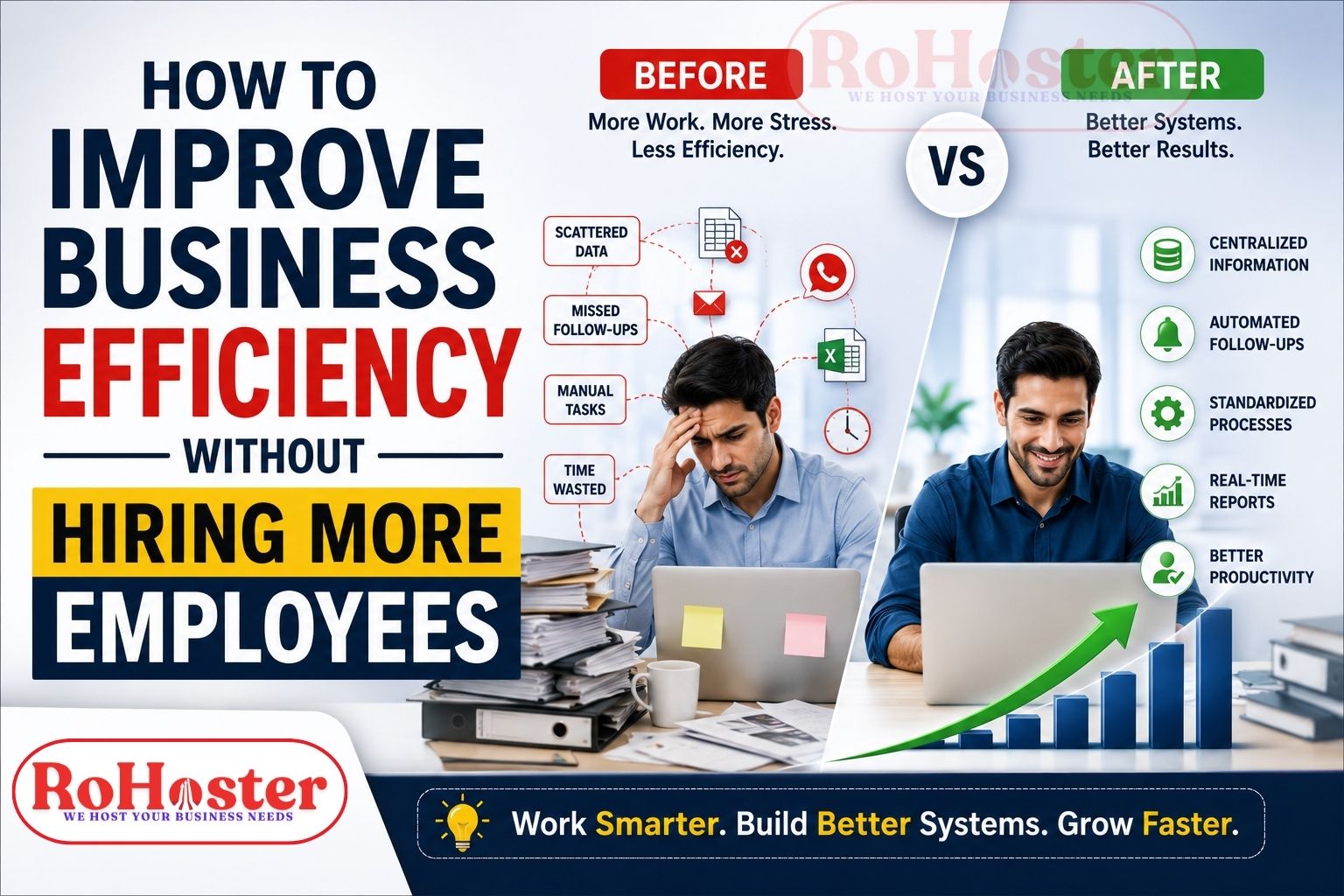
In Business A, they:
- Search through Excel sheets
- Check WhatsApp conversations
- Call different employees for information
- Manually create follow-up reminders
- Prepare reports at the end of the day
In Business B, they:
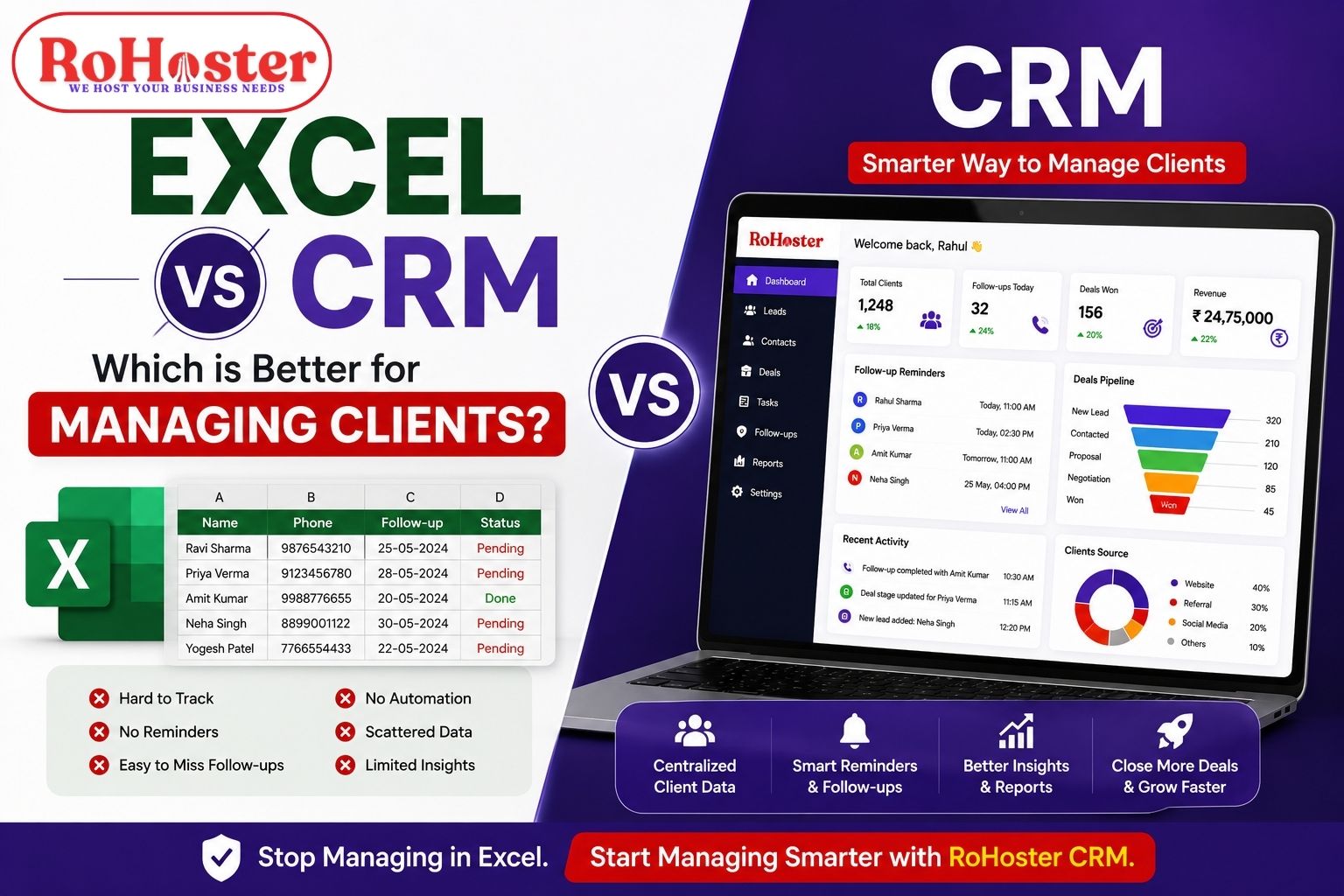
- Have centralized customer information
- Know which leads require attention
- Have scheduled follow-ups
- Can quickly access previous interactions
- Have automated or standardized repetitive processes
- Can generate reports without manually compiling data
Both businesses may have the same number of employees.
But Business B can potentially handle more work because its system is more efficient.
That's an important distinction.
Efficiency is not about making people work harder.
It's about removing unnecessary work.
Why Businesses Hire Too Early
Hiring solves a very visible problem:
“There is too much work.”
But it doesn't always answer the more important question:
“Why is there so much work?”
Suppose an employee spends three hours every day manually updating information across multiple Excel files.
Hiring another employee to help with the same work doesn't necessarily improve the process.
You now have two people doing a process that may itself be inefficient.
Before hiring, businesses should identify whether the workload comes from:
- Genuine business volume
- Repetitive manual tasks
- Poor processes
- Duplicate data entry
- Lack of coordination
- Scattered information
- Unclear responsibilities
- Poor follow-up systems
- Manual reporting
If the problem is operational inefficiency, better systems may solve part of the problem before additional hiring becomes necessary.
Also Read: How to Build a Scalable Business System from Day One
1. Identify Where Your Team Is Losing Time
The first step toward improving efficiency is understanding where time is actually going.
For one week, observe the activities employees perform every day.
You may discover that a significant amount of time is spent on tasks such as:
- Searching for customer information
- Updating spreadsheets
- Preparing repetitive documents
- Checking payment status
- Following up manually
- Creating reports
- Entering the same information multiple times
- Coordinating information between departments
- Looking for inventory details
- Answering questions that could be handled through a standard process
These tasks may appear small individually.
But when repeated every day, they become a significant operational cost.
Ask your team:
“Which task takes a lot of time but doesn't directly create value for the customer?”
The answers can reveal where efficiency improvements are needed most.
2. Stop Entering the Same Information Multiple Times
Duplicate data entry is one of the most common sources of unnecessary work.
Consider a simple customer journey.
A customer sends an enquiry.
The employee records the information in:
- Excel
- CRM
- Quotation document
- Billing software
The same customer information may be entered several times.
This creates two problems.
First: It wastes time.
The employee is doing the same work repeatedly.
Second: It creates errors.
One system may have an old phone number.
Another may have a different spelling.
A third may contain incomplete information.
A more connected business process allows information to move between relevant activities without unnecessary repetition.
This is one of the reasons centralized business management systems can be useful for growing businesses.
3. Create One Place for Important Business Information
Imagine an employee needs to find a customer's previous order.
Where do they look?
Excel?
WhatsApp?
Email?
Billing software?
A notebook?
Another employee's computer?
If the answer changes depending on the customer, the business has an information-management problem.
Important business information should ideally have a central source of truth.
Depending on the business, this may include:
- Customer details
- Lead information
- Follow-up history
- Sales records
- Quotations
- Invoices
- Payment information
- Inventory data
- Employee information
- Business reports
When information is centralized, employees spend less time looking for information and more time using it.
4. Systemize Customer and Lead Management
Sales teams often lose valuable time managing leads manually.
A typical process might look like this:
New enquiry
↓
Employee receives WhatsApp message
↓
Information is written in Excel
↓
Employee calls customer
↓
Reminder is written somewhere
↓
Customer asks for quotation
↓
Quotation is prepared separately
↓
Follow-up is remembered manually
This process can become increasingly difficult as lead volume increases.
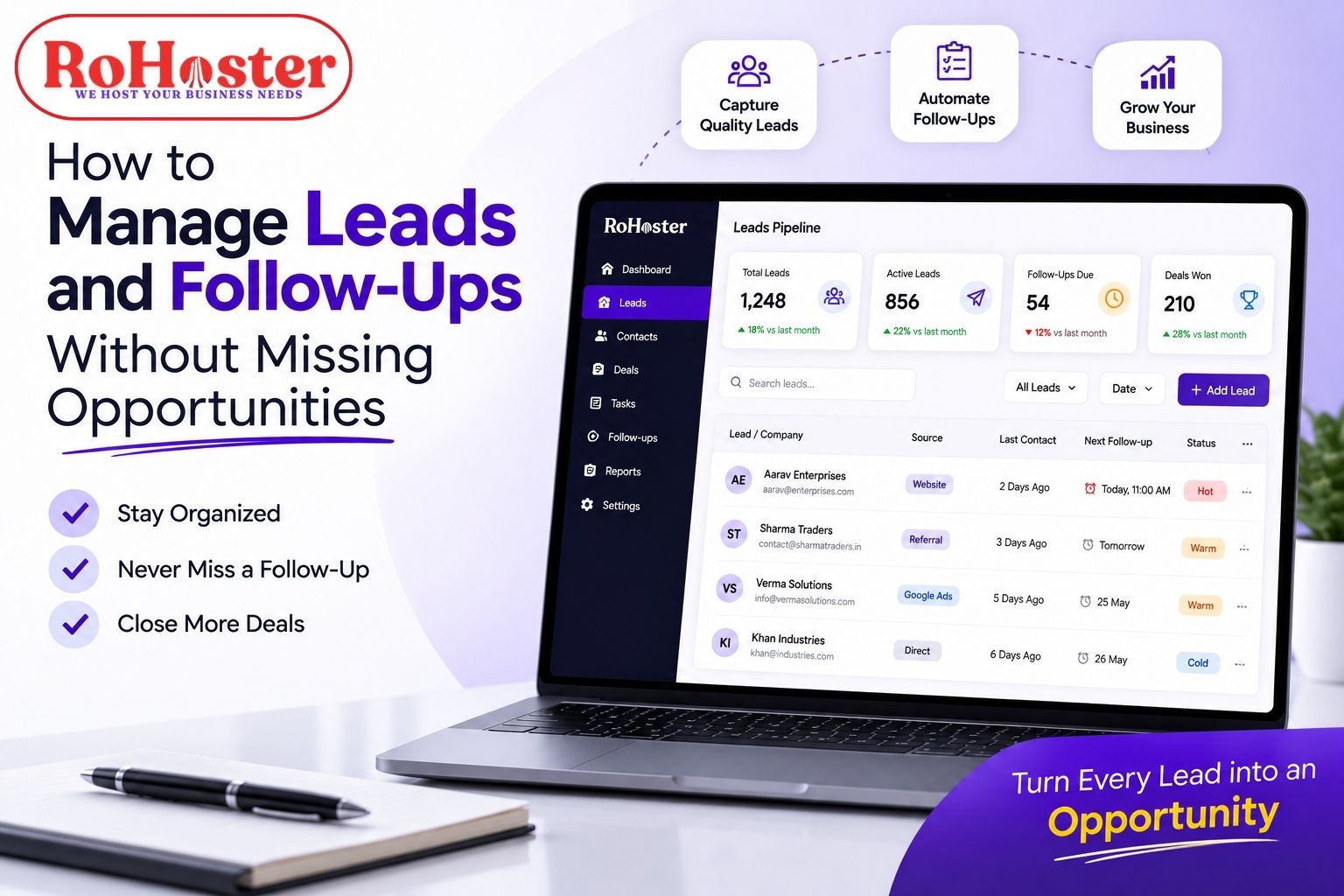
A structured lead management process can make the workflow much clearer:
New Lead → Assigned → Contacted → Interested → Quotation → Follow-Up → Won/Lost
Now everyone knows:
- What stage the lead is in
- Who is responsible
- What happened previously
- What needs to happen next
The objective isn't to eliminate human interaction.
It's to eliminate unnecessary administrative effort around that interaction.
5. Don't Depend on Memory for Follow-Ups
A surprising amount of sales activity can depend on memory.
An employee thinks:
“I need to call this customer tomorrow.”
Then another task arrives.
Then another customer calls.
Then the employee attends a meeting.
By the end of the day, the follow-up is forgotten.
The next day, the same thing happens.
This is why a structured follow-up process is so important.
Instead of relying on memory:
Customer → Next Action → Follow-Up Date → Responsible Employee
The employee doesn't have to remember everything.
The system reminds them what needs attention.
This small change can significantly improve consistency in sales operations.
6. Standardize Repetitive Processes
Not every task needs to be handled differently every time.
If your team prepares quotations, invoices, reports or customer responses repeatedly, create standard processes.
For example:
New Lead Process
- Record lead
- Assign salesperson
- Contact customer
- Understand requirement
- Schedule follow-up
- Update status
New Order Process
- Confirm order
- Check inventory
- Generate invoice
- Record payment
- Update stock
- Complete delivery
Customer Follow-Up Process
- Review previous interaction
- Check pending requirement
- Contact customer
- Record outcome
- Schedule next action
Standardization makes training easier and reduces the amount of decision-making employees need to do for routine activities.
7. Give Employees Clear Ownership
Efficiency becomes difficult when nobody knows who is responsible.
For example:
A new lead arrives.
The sales manager assumes Employee A will handle it.
Employee A assumes Employee B will handle it.
Employee B doesn't know about it.
The customer receives no response.
The problem isn't necessarily employee shortage.
It's lack of ownership.
Every important process should have a clear owner.
For example:
| Activity | Responsible Team |
|---|---|
| New Lead | Sales |
| Lead Follow-Up | Assigned Salesperson |
| Quotation | Sales / Accounts |
| Invoice | Accounts |
| Stock Update | Inventory |
| Customer Support | Support Team |
| Performance Review | Management |
Clear ownership reduces duplication and prevents tasks from falling between departments.
8. Use Technology for Repetitive Administrative Work
Technology becomes valuable when it removes unnecessary manual effort.
Businesses can use technology to support activities such as:
- Lead tracking
- Follow-up reminders
- Customer records
- Billing
- Inventory tracking
- Employee records
- Attendance
- Reports
- Notifications
- Data organization
The important point is that technology should be introduced with a purpose.
Don't automate something simply because automation sounds impressive.
Ask:
“Does this remove repetitive work or improve decision-making?”
If yes, it may be worth implementing.
If not, it may simply add another tool for employees to learn.
9. Avoid Using Too Many Disconnected Tools
This is where businesses can accidentally create another efficiency problem.
They start with Excel.
Then add a CRM.
Then another billing tool.
Then inventory software.
Then an employee management application.
Then another reporting tool.
Each tool may work perfectly on its own.
But employees now have to move between five or six systems.
That creates a new workload:
Tool 1 → Tool 2 → Tool 3 → Tool 4 → Spreadsheet → WhatsApp
Information needs to be copied.
Employees need multiple logins.
Reports need to be combined.
Data becomes fragmented.
For some businesses, using specialized tools makes sense.
But for many small and growing businesses, an integrated platform can be easier to manage.
This is one area where RoHoster can fit naturally.
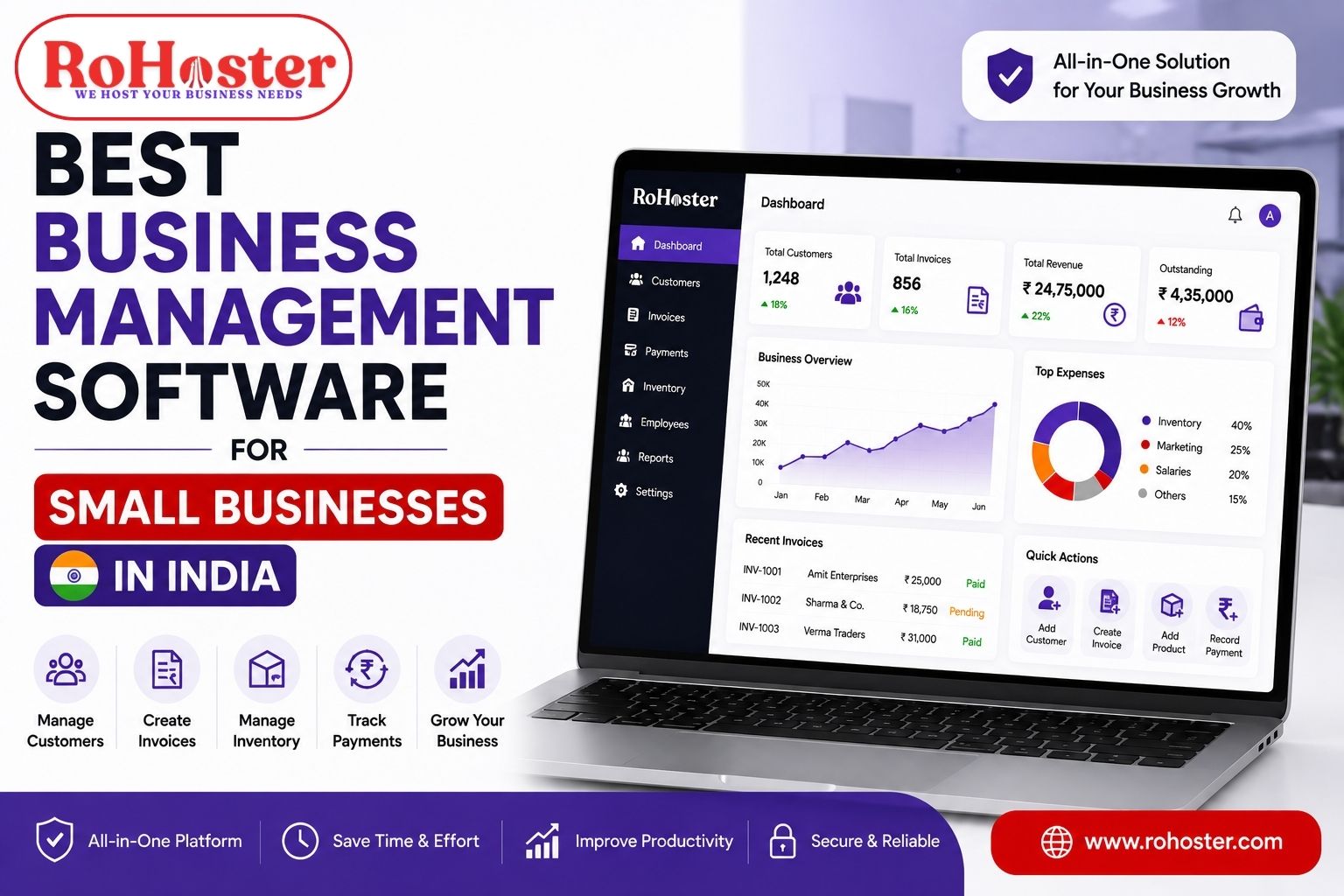
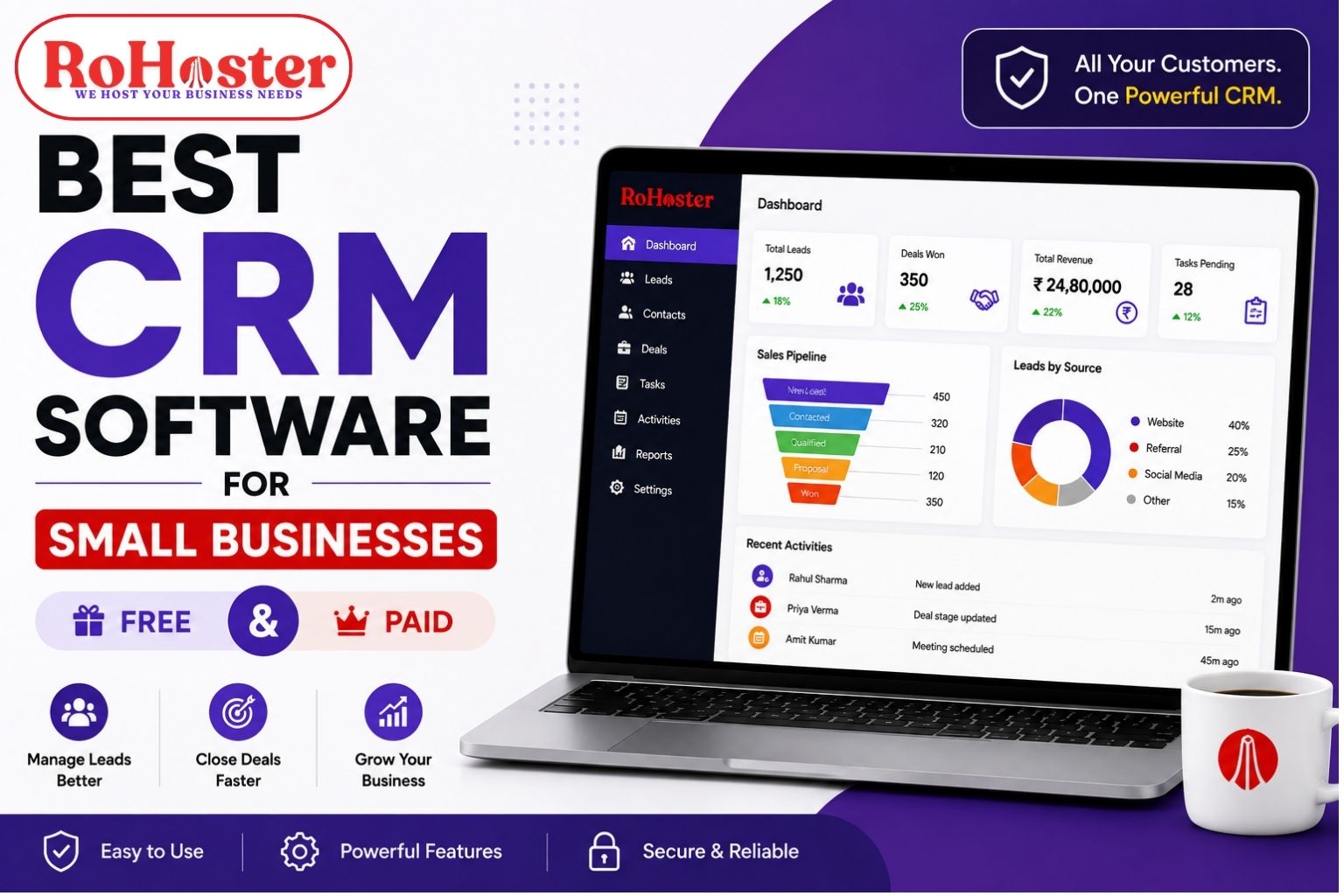
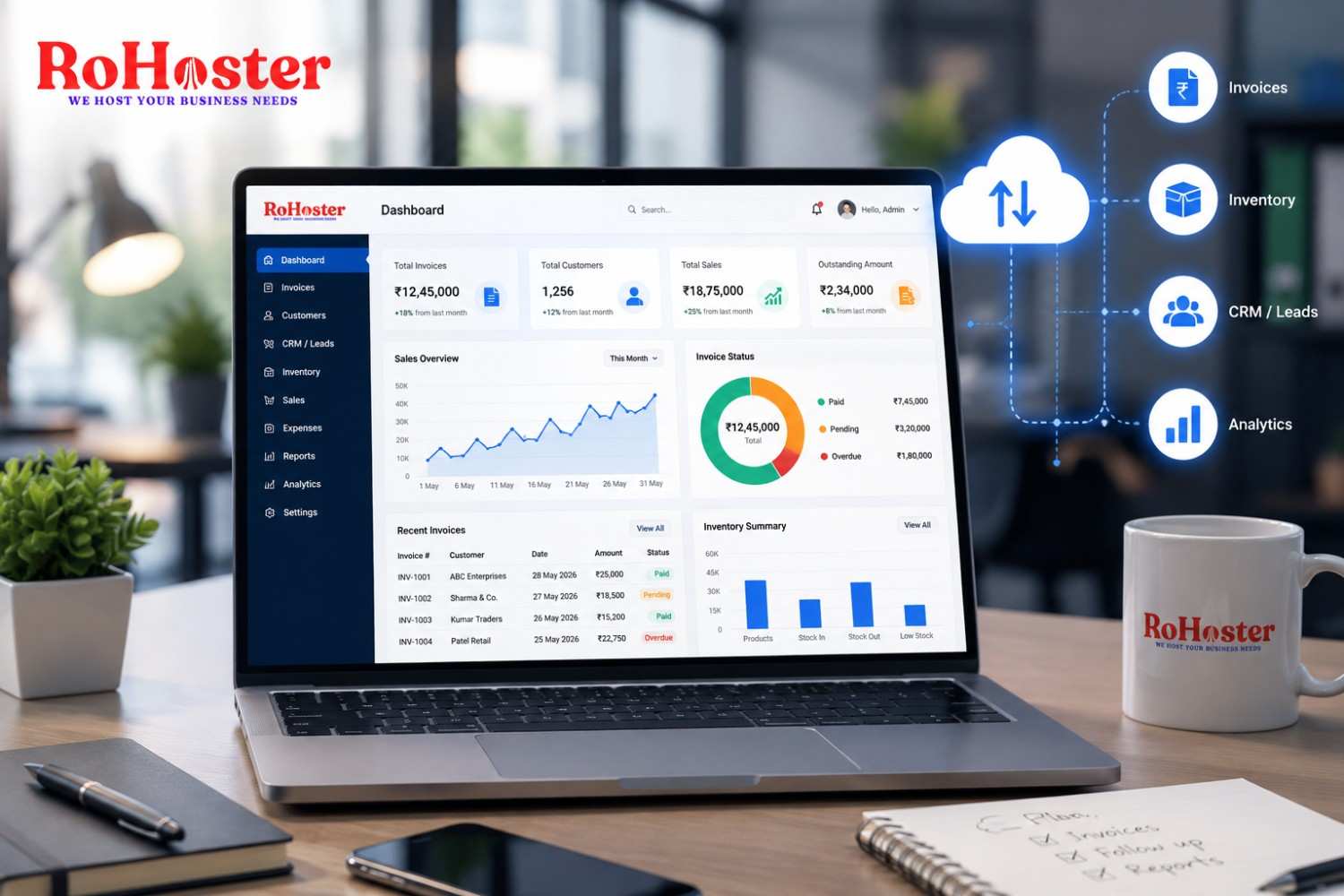
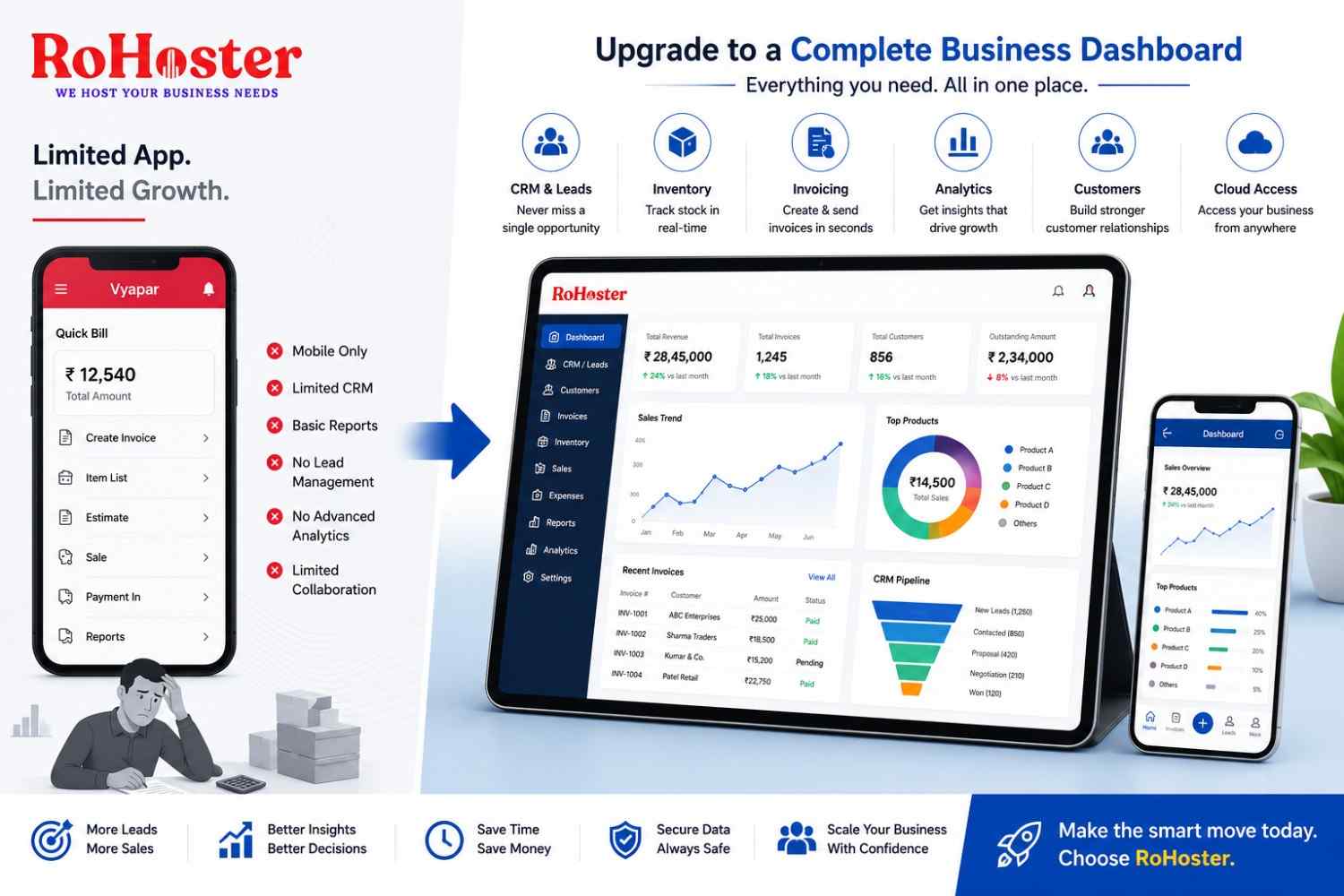
Instead of managing leads, clients, follow-ups, billing, inventory and employee operations across completely separate systems, RoHoster brings these core business functions together in one platform.
The goal isn't simply “one software for everything.”
The bigger goal is:
Less switching. Less duplication. Better visibility.
10. Make Business Reports Easier to Access
Business owners often spend too much time asking employees for information.
“How many leads came this month?”
“How much did we sell?”
“How many invoices are pending?”
“What is the current stock?”
“Which salesperson has the most active leads?”
If answering these questions requires manually collecting data from different sources, management becomes slower.
A better system should make important business information easier to access.
Reports and dashboards can help management understand:
- Sales performance
- Lead pipeline
- Customer activity
- Pending payments
- Inventory status
- Employee performance
- Business trends
This allows business owners to spend less time collecting information and more time making decisions.
11. Improve Communication Between Departments
Many inefficiencies occur because departments operate separately.
Sales may not know the current inventory.
Inventory may not know about upcoming orders.
Accounts may not know whether payment has been received.
Management may not have visibility into any of it.
This creates unnecessary communication.
A connected workflow can reduce this friction.
For example:
Sales confirms order
↓
Inventory sees requirement
↓
Accounts generates invoice
↓
Payment is recorded
↓
Management can see the transaction
When information flows properly between departments, employees don't have to repeatedly ask each other for basic updates.
12. Train Employees to Follow the System
A good system only works when people actually use it.
You can implement excellent software and still remain inefficient if employees continue using:
- Personal notebooks
- Separate Excel sheets
- Personal reminders
- Unofficial WhatsApp groups
- Individual records
The solution isn't to blame employees.
Often, the system is either too complicated or the purpose hasn't been explained properly.
Employees should understand:
Why are we using this system?
What information should be entered?
When should it be updated?
Who is responsible?
What happens if the information isn't updated?
Training should focus on real workflows, not just software features.
Instead of teaching:
“Here are 20 features.”
Teach:
“Here is how you handle a new lead from beginning to end.”
That is much easier to understand.
13. Measure Productivity, Not Just Activity
Being busy doesn't always mean being productive.
An employee may make 50 calls but generate very little progress.
Another employee may make 20 well-targeted calls and close several opportunities.
Similarly:
- More messages don't necessarily mean better customer service.
- More reports don't necessarily mean better management.
- More data entry doesn't necessarily mean better organization.
Businesses should measure outcomes where possible.
For sales:
- Leads contacted
- Qualified leads
- Follow-ups completed
- Quotations sent
- Conversions
For operations:
- Orders processed
- Processing time
- Errors
- Pending tasks
For customer service:
- Response time
- Resolution time
- Customer issues resolved
The objective is to understand whether effort is actually producing results.
14. Remove Unnecessary Approvals
Another hidden source of inefficiency is excessive approval.
A simple activity may require:
Employee → Supervisor → Manager → Owner → Accounts → Manager
By the time the process is completed, significant time has been lost.
Not every decision needs multiple approvals.
Businesses should identify which decisions genuinely require management involvement and which can be handled by employees within defined limits.
This allows the owner and senior management to focus on higher-value decisions.
15. Build Processes That Don't Depend Entirely on the Owner
This is one of the most important steps toward efficiency.
If every decision comes back to the business owner, growth becomes difficult.
The owner may have to answer:
- Which customer should be called?
- What price should be offered?
- Where is the invoice?
- How much stock is available?
- Has the payment arrived?
- Which employee is handling the lead?
A scalable business should gradually move from:
Owner-dependent operations
to
Process-driven operations
This doesn't mean removing the owner from the business.
It means allowing the owner to focus on:
- Strategy
- Growth
- Partnerships
- New opportunities
- Financial decisions
- Business development
rather than constantly solving routine operational questions.
Also Read: Best Business Management Software for Small Businesses in India
When Should You Hire More Employees?
The answer isn't:
“Never hire.”
Hiring is an important part of business growth.
You should consider hiring when:
- Customer demand genuinely exceeds capacity
- Specialized skills are required
- Existing employees consistently operate at full capacity
- New revenue opportunities require additional manpower
- Service quality is being affected
- Expansion requires additional operational capacity
But before hiring, ask three questions:
1. Is the workload genuinely increasing?
2. How much of the workload is repetitive or administrative?
3. Can better processes or technology remove some of that workload?
If the workload is genuinely beyond your team's capacity, hiring may be the right answer.
If the problem is inefficient processes, fixing the system should come first.
A Simple Efficiency Framework for Growing Businesses
Businesses can use a simple five-step framework.
Step 1: Identify
Find the tasks consuming the most time.
Step 2: Simplify
Remove unnecessary steps.
Step 3: Standardize
Create a repeatable process.
Step 4: Systemize
Use suitable technology to manage the process.
Step 5: Measure
Track whether the new process actually improves results.
Then repeat the cycle.
Identify → Simplify → Standardize → Systemize → Measure
This creates a culture of continuous improvement.
The Role of Business Management Software
Business management software shouldn't be viewed simply as a replacement for employees.
Its real value is in helping employees work better.
For example, instead of an employee spending 30 minutes finding customer information, the system can make it available quickly.
Instead of remembering every follow-up, the employee can work from a structured follow-up list.
Instead of manually preparing certain reports, the system can organize the underlying data.
Instead of checking several places for business information, the team can work from a centralized platform.
RoHoster follows this broader approach by bringing together essential business operations such as:
- Lead Management
- Client Management
- Follow-Ups
- Billing
- Inventory Management
- Employee Management
- Attendance
- Business Reports
For a growing SME or MSME, the benefit is not simply having more features.
It is having one organized system that helps different parts of the business work together.
Efficiency Is About Creating Capacity
One of the biggest misunderstandings about efficiency is that its purpose is simply to reduce costs.
That's only part of the picture.
The bigger benefit is creating capacity.
Imagine your existing team can currently handle 100 customers comfortably.
After improving processes, centralizing information and reducing repetitive work, perhaps the same team can handle significantly more customers without compromising service quality.
You have effectively created additional capacity without immediately increasing headcount.
That capacity can then be used for:
- More sales
- Better customer service
- New products
- Market expansion
- Business development
- Strategic planning
That's where efficiency becomes a growth strategy.
Final Thoughts
Growing a business doesn't always mean growing the team at the same speed.
Sometimes the better approach is to first improve the way the existing team works.
Start by identifying where time is being wasted.
Remove unnecessary steps.
Standardize repetitive processes.
Centralize important information.
Create clear ownership.
Improve lead and follow-up management.
Connect billing and inventory processes.
Use reports for better visibility.
And introduce technology where it genuinely reduces manual work.
A business that continuously adds employees to handle inefficient processes may become larger without becoming more efficient.
A business that builds better systems as it grows can create more capacity, improve consistency and prepare itself for sustainable growth.
So before asking:
“Who should we hire next?”
ask:
“What can we improve in the way we work today?”
Because sometimes, the next level of growth doesn't begin with more people.
It begins with a better system.
Work smarter. Build better systems. Grow with confidence.
RoHoster — All-in-One Business Management Software
System Banao. Business Badhao.