Customer Acquisition Cost (CAC): What It Is and Why It Matters
Every business wants to attract new customers and increase revenue. But have you ever wondered how much your business actually spends to acquire one new customer?
You might invest money in advertising, social media marketing, sales salaries, promotional campaigns, and other marketing activities. If you don't track these expenses, it can be difficult to understand whether your customer acquisition strategy is truly profitable.
This is where Customer Acquisition Cost (CAC) becomes important.
Customer Acquisition Cost helps businesses understand how much they spend, on average, to acquire a new paying customer. By tracking this metric, business owners can evaluate marketing performance, manage acquisition expenses, and make more informed growth decisions.
In this guide, we'll explain what CAC means, how it works, how to calculate it, and what businesses can do to improve it.
What Is Customer Acquisition Cost (CAC)?
Customer Acquisition Cost, commonly known as CAC, is the average amount of money a business spends to acquire one new customer during a specific period.
These expenses may include advertising costs, marketing tools, campaign expenses, sales team salaries, and other relevant acquisition costs.
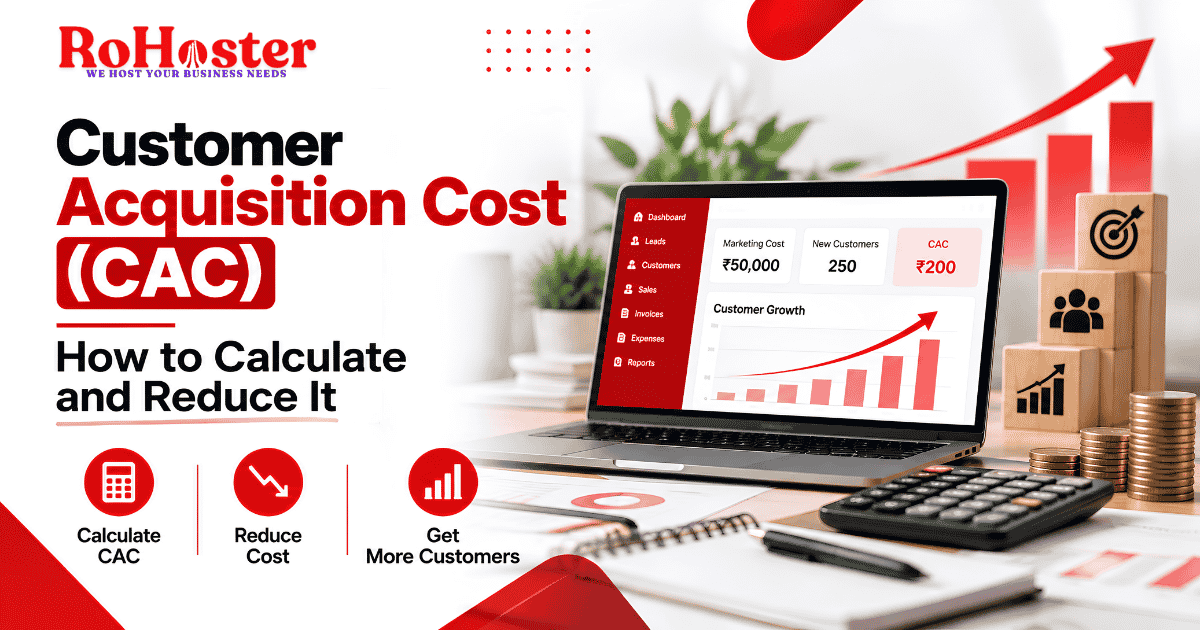
For example, suppose your business spends ₹50,000 on sales and marketing activities in one month and acquires 250 new customers during that period. Your average customer acquisition cost would be ₹200 per customer.
Understanding this number helps you evaluate how efficiently your business converts marketing and sales spending into new customers.
Why Is CAC Important for Small Businesses?
For small businesses, every marketing expense matters. Spending more money on advertising does not automatically mean that a business will generate more profit.
Tracking customer acquisition cost helps you:
Measure marketing efficiency: Understand how much you spend to acquire new customers.
Plan marketing budgets: Make better decisions about where to allocate your advertising and sales budget.
Evaluate growth opportunities: Compare acquisition costs across different campaigns and channels.
Understand profitability: Assess acquisition costs alongside customer revenue and other business expenses.
Make data-driven decisions: Identify opportunities to improve campaigns, sales processes, and customer conversion rates.
CAC becomes even more useful when reviewed alongside customer lifetime value (CLV or LTV), which estimates the revenue or value a customer generates over their relationship with your business.
Together, these metrics help business owners assess whether their customer acquisition strategy supports sustainable growth.
How to Calculate Customer Acquisition Cost (CAC)
Calculating Customer Acquisition Cost is straightforward when you have accurate sales and marketing expense data.
The basic CAC formula is:
Customer Acquisition Cost (CAC) = Total Sales and Marketing Costs ÷ Number of New Customers Acquired
To calculate CAC correctly, use expenses and new customers from the same period, such as one month or one quarter.
A Practical CAC Calculation Example
Let's understand the formula with a simple example.
Suppose a small business records the following expenses in one month:
| Expense | Monthly Cost |
|---|---|
| Digital advertising | ₹25,000 |
| Sales team expenses | ₹15,000 |
| Marketing tools and campaign expenses | ₹10,000 |
| Total acquisition costs | ₹50,000 |
During the same month, the business acquires 250 new customers.
Using the formula:
CAC = ₹50,000 ÷ 250
Customer Acquisition Cost = ₹200 per customer
This means the business spends an average of ₹200 to acquire each new customer.
These figures are illustrative. For an accurate calculation, include the relevant sales and marketing expenses for your business and count genuinely new customers acquired during the same period.
Which Costs Should You Include in CAC?
The expenses included in CAC depend on your business model and the purpose of your calculation. Common costs include:
Advertising expenses: Google Ads, social media ads, and other paid campaigns.
Marketing expenses: Campaign production, promotional materials, and marketing agency fees.
Sales team costs: Relevant salaries, commissions, and sales-related expenses.
Marketing software: Tools used for campaign management, lead tracking, and customer acquisition.
Other acquisition expenses: Relevant costs directly associated with attracting and converting new customers.
For consistency, define which expenses your business will include and use the same approach when comparing different periods or marketing channels.
What Factors Can Increase Customer Acquisition Cost?
Several factors can make acquiring new customers more expensive.
1. High advertising costs: Competitive keywords, expensive ad placements, and poorly optimized campaigns can increase acquisition expenses.
2. Low conversion rates: If many people click your ads but very few become paying customers, your cost per acquired customer may rise.
3. Slow sales processes: Delayed responses, missed appointments, and inefficient follow-ups can reduce the number of customers acquired from existing opportunities.
4. Poor audience targeting: Marketing to people who are unlikely to need your product or service can waste advertising budget.
5. Disconnected business processes: When marketing, sales, and customer information is scattered across different tools, teams may struggle to track performance and identify problems.
Understanding these factors helps businesses identify where improvements are needed instead of simply increasing their marketing budget.
7 Practical Ways to Reduce Customer Acquisition Cost
Reducing Customer Acquisition Cost does not always mean spending less on marketing. Sometimes, improving conversion rates, targeting the right audience, and organizing sales activities can help businesses acquire customers more efficiently.
Here are seven practical strategies to consider.
1. Improve Your Target Audience
Focus your marketing campaigns on people who are most likely to need your product or service. Review your existing customer data to understand which audience segments generate relevant enquiries and paying customers.
Better targeting can help reduce wasted advertising spend.
2. Optimize Your Marketing Campaigns
Review campaign performance regularly instead of judging success only by clicks, impressions, or reach.
Compare campaigns based on qualified leads, acquired customers, and the actual cost of conversion. Allocate more budget to campaigns that deliver suitable customers while maintaining acceptable profitability.
3. Improve Your Landing Pages
A landing page should clearly explain your product or service, its benefits, and the next step a visitor should take.
Use a clear headline, relevant information, a visible call to action, and a simple enquiry form. Test different page elements to understand what helps more visitors become customers.
4. Respond to Enquiries Promptly
When potential customers enquire about your product, timely and relevant communication can help keep the conversation moving.
Create a process for assigning enquiries, recording interactions, and scheduling appropriate follow-ups. This makes it easier for your sales team to manage opportunities without relying entirely on memory.
5. Strengthen Your Sales Process
Identify where potential customers drop out of the sales journey. For example, prospects may lose interest after receiving a quotation or may need additional information before making a decision.
Review these stages, address common objections, and make sure your team understands the next action for each active opportunity.
6. Use Customer Referrals and Organic Content
Satisfied customers may recommend your business to others, while useful blog posts and educational content can attract people who are already searching for solutions.
Build referral initiatives that suit your business and publish content that answers relevant customer questions. These channels can complement paid advertising, although they still require time and resources.
7. Track Business Performance Consistently
Calculate CAC regularly and compare it across relevant periods, campaigns, and customer segments.
Also monitor conversion rates, customer acquisition sources, and customer lifetime value. Avoid reducing CAC at the expense of customer quality or long-term profitability.
How Business Management Software Can Support Better Marketing Decisions
As a business grows, marketing information, customer records, sales activities, billing, and operational data can become difficult to manage across disconnected tools.
Business management software can help centralize important workflows and give teams a more organized way to manage daily activities.
Depending on its features, a platform may help businesses maintain customer records, track sales progress, coordinate team responsibilities, and review relevant business information.
For example, a team that maintains accurate lead records and follow-up activities may find it easier to identify missed opportunities and improve its sales process. However, software alone does not guarantee lower acquisition costs; results depend on implementation, data quality, and how effectively the team uses the system.
Explore RoHoster for Organized Business Operations
RoHoster is a business management platform designed to help businesses organize leads, customers, billing, inventory, employees, attendance, and other operational activities in one place.
If your business struggles with scattered records or disconnected workflows, you can explore whether RoHoster's available features fit your team's requirements.
Visit RoHoster to learn more about the platform.
Frequently Asked Questions About Customer Acquisition Cost
What is a good Customer Acquisition Cost?
There is no universal ideal CAC. It depends on your industry, pricing, profit margins, customer lifetime value, and business model. A useful benchmark is one that supports sustainable profitability while allowing your business to grow.
How do you calculate CAC?
Divide the relevant sales and marketing costs incurred during a specific period by the number of new customers acquired during that same period.
CAC = Total Acquisition Costs ÷ Number of New Customers
What is the difference between CAC and CPA?
Cost per Acquisition (CPA) is a broader term that may measure the cost of a specified action, such as a lead, registration, purchase, or other conversion. Customer Acquisition Cost specifically measures the cost of acquiring a new customer. The exact definitions can vary by business and reporting system.
What is the relationship between CAC and customer lifetime value?
Customer Lifetime Value (CLV or LTV) estimates the value a customer generates over their relationship with a business. Comparing LTV with CAC helps businesses assess whether customer acquisition is economically sustainable. Revenue-based LTV and profit-based LTV are not interchangeable, so use a consistent definition when comparing them.
Can small businesses reduce CAC without increasing their marketing budget?
Yes. Businesses can work on audience targeting, landing-page conversion, sales follow-ups, customer referrals, and the efficiency of existing campaigns. These improvements may help acquire customers more efficiently without automatically increasing spending.
How often should a business calculate CAC?
Many businesses calculate CAC monthly and review it quarterly for broader trends. Businesses with high campaign volumes may also monitor it more frequently. Choose a reporting period that provides enough reliable data for meaningful comparisons.
Conclusion
Customer Acquisition Cost is an important metric for businesses that want to grow while managing their marketing and sales expenses responsibly.
By understanding the CAC formula, reviewing acquisition costs, improving campaign targeting, and strengthening sales processes, businesses can make more informed decisions about customer acquisition.
The goal is not simply to achieve the lowest possible CAC. It is to acquire the right customers at a sustainable cost while building a profitable business.
For businesses looking to organize their leads, customer information, and daily operations, exploring a centralized business management platform such as RoHoster can be a useful next step.
Learn more at https://rohoster.com/.